 Score: 90/100 (9.0 out of 10)
Nurse Florence, What is Endometriosis? is yet another ambitious medical-themed children's book by Michael Dow. This specific book tackles the subject of endometriosis, something which can be a touchy, uncomfortable, or even scary subject to young people enduring or experiencing puberty, specifically girls and young women. However, like asthma (the subject of Dow's previous book), endometriosis isn't a foreign, alien, mysterious thing that only affects a few unfortunate people, it's actually a common condition that affects millions of women around the world—about 10% of the female population! So, realistically, this is a very important subject to a whole lot of people! This book follows Jean, Condi, and Sonia, three curious (some would say precocious) students who frequently appear in this series in one iteration or another. Similarly, Nurse Florence appears, as she does in every book in the series, however, she takes the form of middle-aged Caucasian woman (in the previous books, she was a woman of color). This indicates to us that Nurse Florence isn't necessarily one person but an amalgamation of people who represent and embody Florence Nightingale, the mother of nursing. This version of Nurse Florence addresses a prompt that the girls present her about a problem that only affects women. The nurse is then able to provide a lot of enlightening and invaluable information about endometriosis, a condition in which, during the process of menstruation, tissue like the lining of the uterus leaves the uterus and grows outside of it as scar tissue, causing pressure and pain. The nurse is able to go over six causes of endometriosis: retrograde menstruation, hormones and immune factors causing endometrial-like cells to form outside the uterus, embryonic cells transforming into endometrial-like cells outside the uterus, surgery in the reproductive area, an endometrial cell being transported through a vessel outside of the uterus, or an immune system disorder. She is also able to explain which populations are more likely to get it (such as women who've never given birth, heredity, or people being exposed to estrogen for a prolonged time), different ways doctors test for endometriosis, and some ways to alleviate its symptoms like pain medication and a warm bath. There are also some scary consequences to endometriosis. The one that stood out to us is never being able to have kids. We'd say that this book is decent and provides a lot of important information. It has some issues, however, that have existed since the first Nurse Florence book we read (Nurse Florence, How Do We Grow?). First, the author seems to struggle with storytelling, dialogue, and establishing proper character motivations. Characters need motivations. There needs to be a reason why the characters are so interested about a particular topic. It's awkward and weird when some kids walk up to some lady and ask her to talk to them about an issue that only affects women. Wouldn't it make more sense if one of the girls was just starting to menstruate and was experiencing cramping, so the girls—being good, caring friends—ask the nurse about it? Now, in Nurse Florence, What is Asthma?, the central character, Jean, had a motivation to ask the nurse about asthma, it's because she was suffering from it. In fact, it was affecting her ability to keep up with her friends in physical education and sports. So, we could understand why she would ask the nurse about it. What motivation did these girls have to just randomly sprout this “women's issue” prompt on Nurse Florence? Doesn't that seem forced, contrived, and unnatural? Did they all just have nothing better to do? Kids love to play video games, ride bikes, and compete in sports. Some of them love to read. Most kids don't walk up to a school nurse and ask them to take time out their day to talk to them (presumably for 30-60 minutes) about a condition we have no idea they suffer from or not. There's a quick and easy fix: have a restroom scene, cropping the private parts out (of course), in which one of the characters is menstruating and experiencing pain, perhaps even calling to a friend in another stall about it. That solves this core issue. Another issue is that most people who read this book will be young women who may be experiencing endometriosis and want a solution to help alleviate their pain (and possibly panic). Well, the solutions are relegated to the very end of the book, and they're quite sparse. It might have been better if the nurse had identified the problem one of the girls was having EARLY in the book (perhaps in the first 10 pages) and then was able to get permission from the girl's parents to give her ibuprofen. That's another quick fix. Doesn't that make more sense? A third issue with this book is that the dialogue is still clunky and strange. It isn't formatted properly. When multiple people are talking in dialogue, you're supposed to create a new paragraph for each new line of dialogue. Well, in this book (like the other Dow books we read), all of the dialogue is clumped together in one block of text. This can make it difficult to distinguish between who is saying what. The framing of each of these books is also a bit weird. Instead of us being naturally introduced to characters doing stuff, the author always introduces them like they're in a stage play (and not prose) with a “Background” page that sets the scene. We'd advise against doing this because it's not really a way to endear us to the characters. Instead of having a “Background” page, just introduce us to the characters as they appear and as the action is happening. Nurse Florence, What is Asthma? worked, despite its far inferior illustrations, because it kicked off with the central character actually doing stuff, trying to perform well in P.E. despite a condition affecting her breathing and energy levels. Why couldn't this book have started out in a similar way? Maybe with Sonia experiencing cramps during dodge ball or something. Maybe she doesn't get to first base or home because the cramps are so bad. Isn't that so much more exciting and interesting than three girls finishing class and randomly deciding to ask a nurse a seemingly random question? We talked about the illustrations, and these might be the best in a Nurse Florence book in terms of quality. However, we would argue that the illustrations don't seem to fit the subject and feel of the book. This style would fit more in a more sophisticated book about traveling to Paris or protesting for human rights, but this is a children's book. It's supposed to be soft and smooth. This book is supposed to be covering a rather painful, uncomfortable, and scary subject for girls. However, we're presented with the least comforting, least appealing, and most scary-looking Nurse Florence yet. The other Nurse Florences had soft, inviting, welcoming, and comforting features. This one has wild, red, wiry hair and a million-yard stare that pierces your soul. Most disturbing of all, she has this really creepy, unsettling smile that never goes away, even when she's talking about the frightening consequences of endometriosis. Shouldn't she look a little sad or have a frown while talking about never being able to bear children? At least the three other characters look great, but it's just the same image of them used throughout the book. With that said, again, these are probably the best illustrations in a Nurse Florence book. Lindsay Roberts, the illustrator, is far and away the most experienced (and arguably skilled) artist in the series so far. However, we're not sure if the style really fits the target demographic. It also brings up another issue: there is so much inconsistency and lack of continuity in this series. Every book in this series features a different Nurse Florence, a different Jean, a different Sonia, and a different Coni. Every book in this series features a different artist with a completely different style, usually one that's jarring or clashes with the style of the previous book. Could you image a 23-episode animated series that changed its animation style every episode? Wouldn't that drive you nuts? There is such great information in every book in this series, and the concept is great, but the execution is hit or miss. There are so many ways in which books in this series could be easily improved: have characters with continuity and motivations rather than changing them every time, hire one illustrator with one style to illustrate the whole series, and either write in proper prose or have a skilled, professional ghost writer do it. In film-making, there are people who produce, people who do the screenwriting, and people who direct. Similarly, in publishing, there are writers, editors, and illustrators. It seems to us like this author may be a producer—someone with an awesome idea and concept but who should really put the execution of that idea and those concepts into the hands of people who can make them work. We want to see this series succeed because it covers topics that are important to the health, safety, and education of young people. Check it out on Amazon!
0 Comments
 Score: 95/100 (9.5 out of 10)
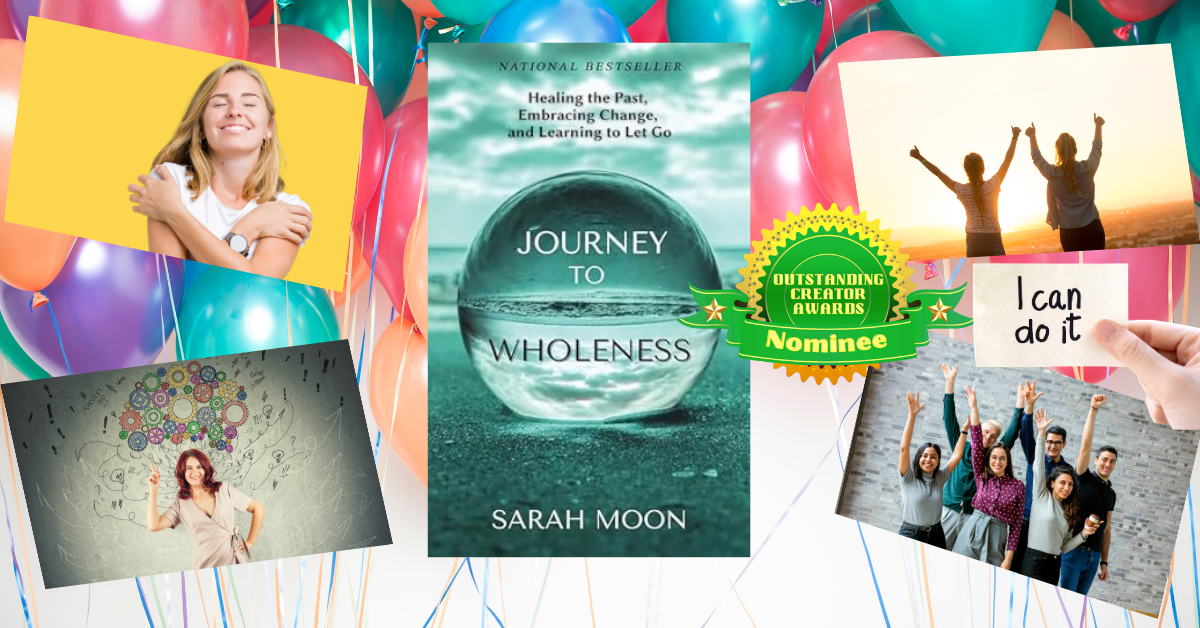
Journey to Wholeness is an excellent self-help, Christian book by Sarah Moon! The subtitle of the book (Healing the Past, Embracing Change, and Learning to Let Go) reflects the nurturing, comforting, healing nature of this book. However, it's so much more than that. This is a book about being a better person, being a happier person, and living your best life—the life that God intended for you. This is a book about attracting happy, positive people into our lives. It's a book about nurturing positive thoughts and feelings. It's a book about looking at everything from a different lens and from a different perspective from what we're used to. It's a book about learning from mistakes rather than letting them defeat or destroy us. It's a book about letting go of self-destructive feelings like envy, jealousy, and resentment. It's a book about controlling the controllables and leaving the rest up to God. In a lot of ways, this is a self-help book with a similar feel to something like The Stress Book by Dr. Terrence Foster or The Power of Wholeness by Dr. Verlaine Crawford, however, is far more condensed and concise. Author Sarah Moon's story, though mostly in the background of this book and not expanded on, stands out as incredibly compelling and inspiring for the amount of time it is given. Both of her parents passed away from illness within months of each other. Having immigrated from Brazil to Utah, USA, Moon was forced to go back to Brazil and pick up the broken pieces of her past (in a sense). So, Moon presents this information as someone who has walked the talk—as someone who has remained positive and trusted God despite all the slings and arrows that life could throw her way. This book is not just inspiring, but it is also quite well-written and eloquent, although there are a few missing words and small errors here and there. Some of our favorite quotes are: “I’m attached to nothing and open to what life brings.” “Just very different perspectives. Same movie, just different optics.” This quote regards how some people view situations differently—a fan of romance would focus on the romantic aspects of a film while a history buff might focus on the historical accuracy (or inaccuracy) of it. This doesn't make one right or the other wrong, it's just a matter of looking at things from a different lens. “Do you let a pebble on your path stop you from finishing the journey? Pebbles can be stepped over, rocks give you a better view if you use it as a stepping stone to see what is ahead and bolders[SIC] develop muscles or the ability to go over, around it or explode it out of the way. To some, a pebble is all it takes to destroy focus. Don’t let it be you! A pebble sinks into the ground if you step on it. No other thought should be given to it!” “Resentment is like drinking poison and then hoping it will kill your enemies.” (Credited to Nelson Mandela) “Dreaming with God is the same as entering a miracle factory and running the place for our profit. Pleasures come in many ways.” “Perspective is truth wrapped in emotions.” “...you ask 'What if I fall?' Oh but my darling, 'What if you fly?'” (Credited to Erin Hanson) This book packs a punch in less than 200 pages, similar to something like No Perfect Love by Alyson Nerenberg. Check it out on Amazon! 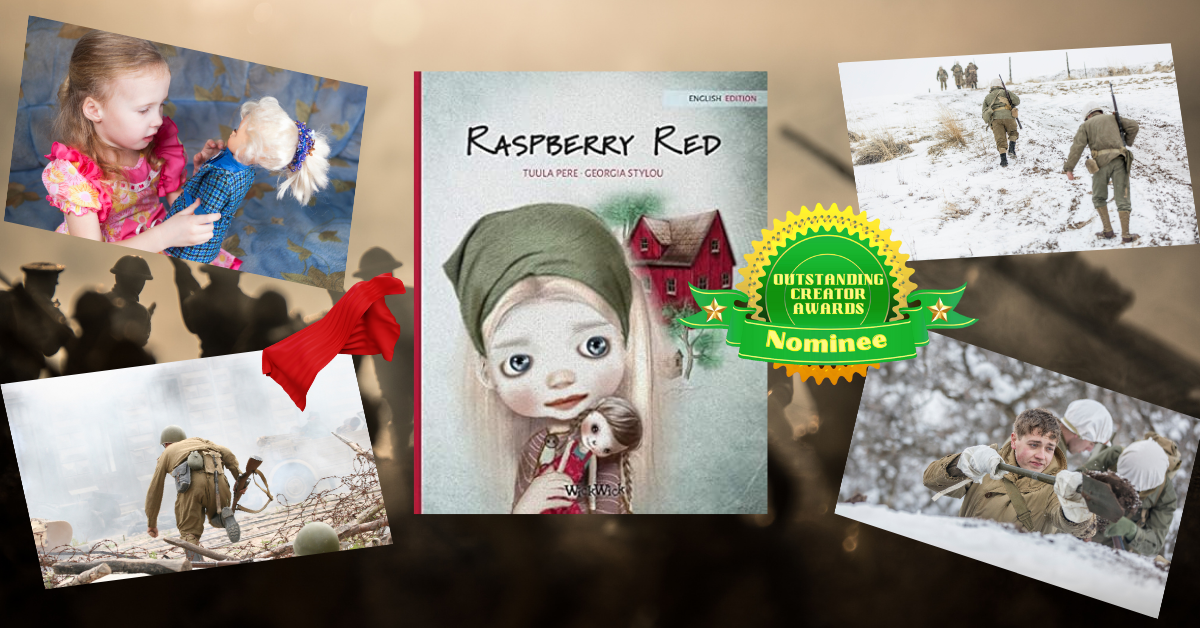 Score: 92/100 (9.2 out of 10)
Raspberry Red joins Tuula Pere's phenomenal line of anti-war children's literature that includes former award-winning books Mother's Bread Dough and Between the Walls. Ironically, it also fits right in with the plot of the Pere book that we just read, Lullaby of the Valley. This book follows a little girl named Aino who lives in a town that is in the middle of an active war-zone. Aino is an innocent victim of this war over which she has no say or control. The conflict impacts where she can safely stay/live, the foods she can eat, or even the things she can keep and bring with her. Case in point: her prized red-caped doll which her grandmother crafted for her. In the climax of this book, Aino encounters two enemy soldiers. In her haste to hide and run from them, the prized red cape is torn from her doll and falls in the snow. While Aino escapes, she escapes without her doll's red cape. Fleeing the warzone and becoming a refugee, Aino doubts she'll ever get the cape, her most sentimental item, back. However, in a beautiful twist, one of the enemy soldiers who is—we can assume—empathetic to her, finds her cape and hangs it where she can find it. They even spare her playhouse (though they cause a lot of other destruction). This book has a really beautiful and powerful message about looking at the things we have in common rather than what sets us apart—humanity in the midst of a horrific situation like war. There are certain things that bring us together, like the love of a grandmother, or a child's toy. The fact that the enemy soldier recognized how valuable the cape was without having to be told is one of the most powerful moments we've experienced in literature. We'll say that we liked the illustrations (by Georgia Stylou) a little more than those in Lullaby of the Valley, mostly because they were more colorful and generally appealing. That seemed necessary since the book had to highlight the redness of the cape, which is a major plot device. However, the illustration can be off-putting at first, especially getting used to the Bratz-doll look and style of the character design. However, it kinda fits. Since this book centers around a girl and her doll, it kinda makes sense that the character herself would look like a doll. It is also a bit wordy for a children's book, but we won't hold that against it too much. What we did notice is that, because of the wordiness, the text had to be smaller, which can make it a bit hard to see. However, this isn't as extreme a case as we've seen before. We really liked the presentation and message of this book. Check it out on Amazon! 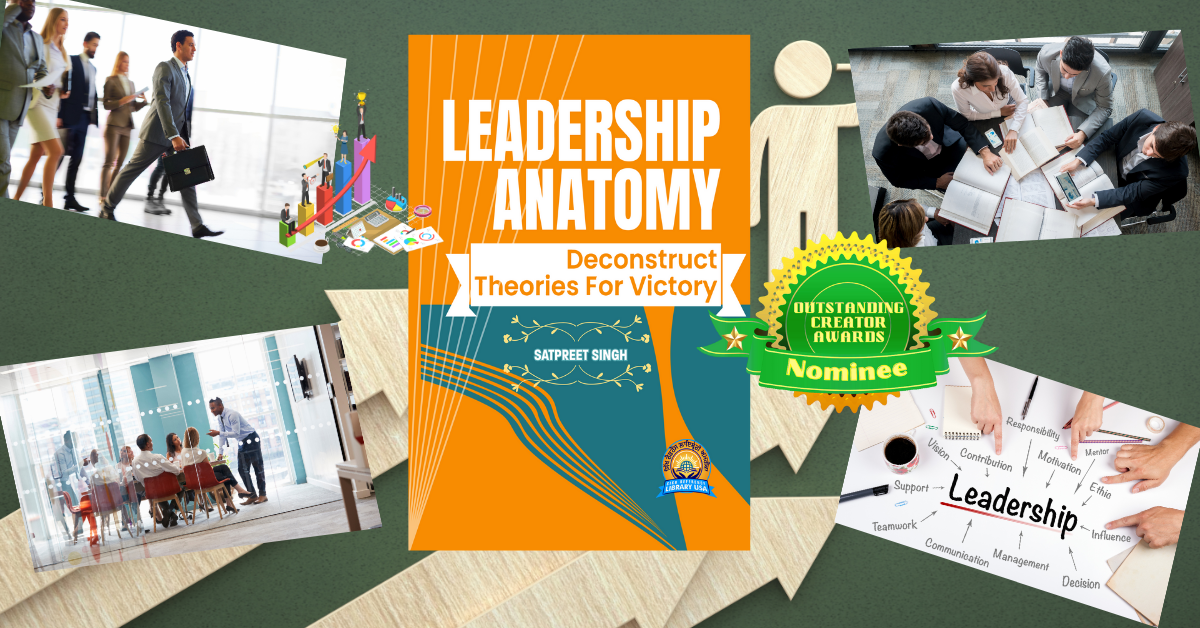 Score: 96/100 (9.6 out of 10)
If you don't already know, a 9.6/10 is the highest score we've ever given a book of any kind. Well, this phenomenal book and this extraordinary author definitely deserve that high honor! Leadership Anatomy: Deconstruct Theories for Victory is an absolutely phenomenal, ambitious, comprehensive, and enlightening book by Satpreet Singh! While focusing on the topic of leadership, particularly in regards to business, this book crosses several other genres including self-help, reference, sociology, economics, history, and even psychology! This is truly an exhaustive, encyclopedic look at all facets of leadership, looking at the topic from every angle—from every nook and cranny! And, we have to say, it was both a pleasure and an honor to read! Where do we even begin? Well, the author chooses to literally start from the beginning, using example from history: from ancient times and antiquity. Ultimately, since human beings have started forming group, we have always needed leaders. It's natural for a group to have a leader (or leaders), whether they be a chief, a lord, a king, a CEO, or a president. Groups of people are naturally inclined toward having someone who is large and in charge. And there are various good examples and bad examples of leaders throughout history. There are good leaders like Abraham Lincoln and Maharaja Ranjit Singh, the father of the Sikh Empire in Punjab. It's incredible how the author was able to educate us about various great leaders from the part of the world that he grew up in, something which is less familiar to a western/American audience. We weren't perturbed by this at all. In fact, we welcomed it! We were impressed by all of these great leadership examples that we'd never heard of beforehand. For example, the author was able to talk about Bhai Kanhaiya Ji, a Sikh leader who embodied the cardinal trait of empathy. The author is then able to switch immediately back to a more familiar figure like Martin Luther King Jr. and how he embodied another cardinal trait: vision. The author is also able to talk about someone like Sardar Jassa Singh Ahluwalia, who helped to lead Punjab through a period of division and turmoil, as an example of both a charismatic figure and as an example of the laissez-faire leadership style, one of the many leadership styles that Satpreet Singh discussed. Some of those leadership styles include autocratic, democratic, laissez-faire, and transformational. You would think that one of these leadership styles would be superior to the others, however, that's not true 100% of the time. In a time of crisis, war, or during an emergency when quick, decisive decision-making is paramount, the often-vilified autocratic style might actually be best. However, under autocrats, people can be afraid to share new ideas and thus innovate. It can also lead to abuses of power like with the many genocidal tyrants throughout history. Often times, a laissez-faire approach can be preferable as it nurtures a sense of freedom, autonomy, and involvement while also encouraging creativity and innovation. However, along with the democratic style, it can be slower and can even become chaotic. The transformational leadership style is something that really intrigued us, as it was probably the one we knew the least about. A transformational leader is usually someone with great charisma who can compel or convince people to change their way of thinking and acting, toward shared visions and values. Jesus might be an example of a transformational leader as the founder of a new religion. You heard us briefly talk about cardinal leadership traits with regards to Martin Luther King Jr. and Bhai Kanhaiya Ji. Well, there are different levels and kinds of leadership traits that the author discusses as part of “Trait Theory” including cardinal traits, central traits, and secondary traits. Trait Theory is one of many leadership theories that the author explores and deconstructs throughout the book, alongside things like the Great Man Theory, Contingency Theory, Behavioral Leadership Theory, Vroom Decision-Making Theory, and more. What's great is that the author doesn't present any of these theories as 100% factual or 100% true 100% of the time. However, he still gives them their day in the sun and provides the information for you to read and analyze yourself. The Great Man Theory, for example, is extremely interesting and fascinating. A part of you wants to believe it. It can be inspiring to think that you could be one of those great men who, someday, could remembered for changing or shaping history. However, what about the women? And what about the billions of middle-class and working-class people working nine to five jobs, making the economy go 'round. Should their bosses and business executives get all the credit? Should a president or general get all the credit for winning a war when their soldiers poured their literal blood, sweat, and tears into fighting it? When you think about it like that, even a great theory like the Great Man Theory can come into question. The author did as good a job as humanly possible at staying as unbiased as possible. There were also many other fascinating topics discussed in this book like nature versus nurture, emotional intelligence, adaptability, nurturing a growth mindset (instead of a fixed one), strengthening your vision and strategic thinking, encouraging innovation, empowering people, and gaining/building trust. These aren't just things that can help you in leadership or business, these are things that can help you in your everyday life! Check it out on Amazon! 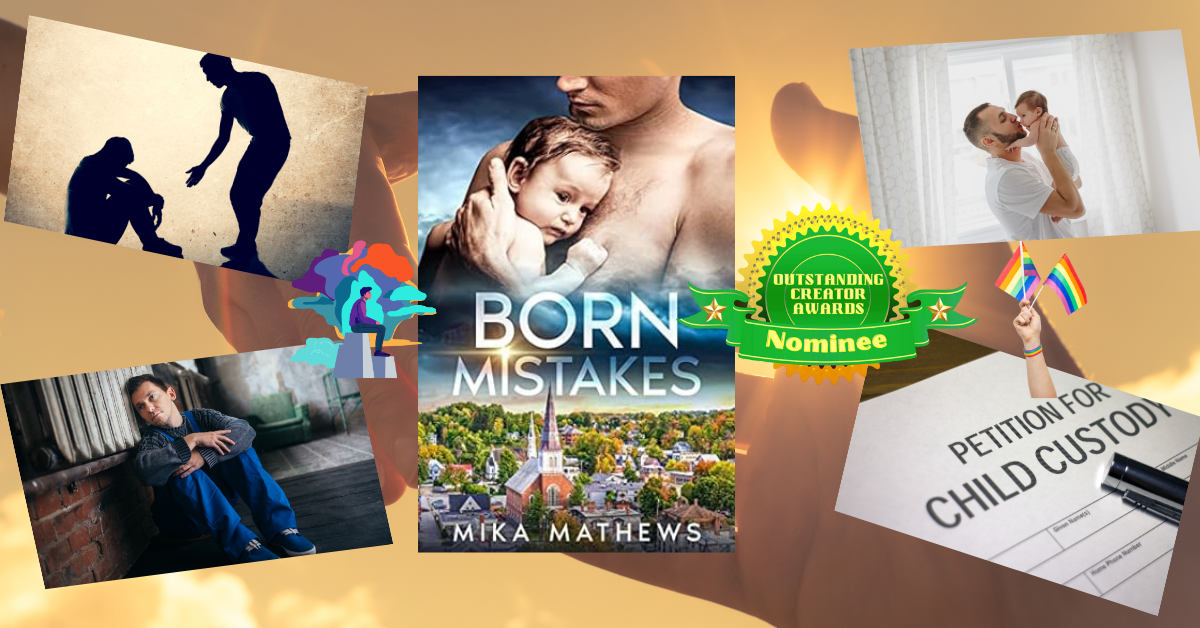 Score: 85/100 (8.5 out of 10)
Born Mistakes by Mika Mathews is a novella with tremendous promise and potential. It follows a new father named Davis who is wrestling with the stigma of having a child out of wedlock with few resources in addition to his own personal demons. Joining him is Deven, an old classmate who comes back into his life as a hot mess, near-homeless, hopeless, and directionless. This short book had the potential to be an incredible LGBTQA+ story. The pieces were all there. The premise was great. Heck, the blurb is straight fire. However, this book has several problems. First of all, because it is so short, it also feels extremely rushed. Even though there are discussions of the two main characters having known each other in school (and, thus, have a bit of a past), there isn't enough time to elaborate on these things. There's not enough time to flesh this relationship out and make it feel earned and legitimate. One minute, these two are on their own, the next minute they're living together with only one character (Mitchell) pointing out that this is a bit odd and questionable. Another thing that was a bit bothersome were the names of these characters. One of them is named Davis Johnson, and if you know anything about a popular channel called MrGo30, you'd realize how hilarious this name is. It's like calling a character “Smith Black” or “John Doe.” However, the main problem with Davis's name is that it looks and sounds way too much like the name of the other character, Deven. The names start with the same letter and are the exact same length (five letters). Why is this such a big deal, you might ask? Well, it's because it's way too easy to get these two characters mixed up. It can be needlessly confusing. It seems like the author has a thing for main characters whose names start with “D” (like Dante from their main series), however, this is a case where the author probably should've parted with that idea. It's too problematic to have two main characters who have names that are barely distinguishable from one another. So many times, we had to stop and quiz ourselves: Wait, which one is Josiah's dad? Which one has the depression? Which one is vegan? Which one doesn't eat and possibly has an eating disorder? Which one got abused and had to go into foster care only to turn 18 and not qualify? Which one is bisexual and asexual? Which one has the issues with child-protective services despite clearly having sole-custody of the child? Well, it turns out that both have had issues with child-protective services. However, the answer to most of these questions is usually DEVEN. For some reason, Deven is the one who has most of the baggage. Deven is the damsel in distress who needs to be saved, possibly from himself. What makes us say that? Well, Deven reminds us of that person who loves to whine, complain, and blame everyone else for their problems. We have no love loss for Deven, which is unfortunate because the reader having sympathy for him is the crux of the entire book. Without sympathy, Deven has nothing and is nothing. That's true both in literary terms and in terms of the life of his character. He seems like a self-pitying person who thrives on the sympathy of others feelings bad for him. We know that might sound harsh, but it's true. We don't sugarcoat things. We provide constructive feedback. You shouldn't just give all of your problems to one character and turn them into a walking manifestation of mental illness. Give them one mental illness, then have the other things about their character branch out from that. Instead, Deven comes across as a problem. He comes across as trouble. He comes across like a ball and chain or an anchor—a liability. If you pay attention to some of the things that Deven claims (and how he claims them), he comes across as sketchy. Now, this was clearly not the intention of the author as Deven is eventually able to summon the guts to do something brave and heroic. However, for much of this book, he reminded us of the crooked, evil twin brother from Secrets in the Mirror by Leslie Kain, the one who became so dependent on drugs and possessed by his inner turmoils that he disrupted the lives of his own family to get what he wanted. Deven explains his dysthymia (low-grade depression) not just once but twice in a book that's only 70 pages long. He explains it twice in a span of 20 pages! Do you know what that tells us? That tells us that he is needy, self-pitying, craves attention, and uses this sob story like a tool to get what he wants—ultimately favors from people like Davis. You can just tell that he tells this same sob story to people all the time. Among the other suspicious things that Deven talks about are his domestic abuse, veganism, potential eating disorder, and the cloudy circumstances under which he was kicked out of his family. Now, although the ending makes it rather clear that his parents resent him, you can't help but wonder as an outside observer—is Deven not at least somewhat responsible for this problem? Think about it. What if Deven's parents were actually trying to help him before all of this occurred? What if they were trying to feed him after he'd started playing around with cult-like ideas like fasting and extreme dieting? What if they realized that he was starving himself or was becoming sick due to the way/things that he ate? What if they were trying to get him to take his antipsychotic medications or antidepressants, but he was straight-edge (against medicine) and refused? What if they were trying to get him professional help, but he instead refused and continued to be a menace to society? What if they gave him an ultimatum: fix your act, start eating normally, take your medications, get professional help, or get out of here and never come back? We've been there. We've seen it. This is what an intervention sometimes boils down to. You can love some people to death, but it's ultimately their choice of how to live their life and what to do with it. Sometimes, you've gotta tell them: the door is open, go live your life the way you want and suffer the consequences, just not under my roof. For example, imagine having someone in your household who repeatedly harasses and threatens people online, so much so that it becomes criminal and the cops keeping coming to ask them to stop. Would it be immoral to then say: either you stop harassing and threatening people, or you get the hell out of my house? It happens! That doesn't make the parent bad or evil, necessarily. Likewise, that doesn't make the person who got kicked out an innocent victim all of a sudden. There are two sides to each story. Remember: Deven called CPS on his parents three times. We aren't told specifically why he did this, only that he claimed abuse. CPS did not see evidence of this, at least the first two times. What if it were one of the scenarios we described above? Through the things he said, Deven actually gave us all the ammunition we needed to think that was possible (if not probable). Now, it's clear that both Deven and Davis are gay (well, actually, Davis is bi and Deven claims to be gay and asexual). So, what if Deven were kicked out for being gay? Now, that would be messed up. However, like we said before, we think there's more to this than meets the eye. We think there's more to this story than Deven just being gay and being kicked out. He obviously had other issues and problems. The way that he talks about and demeans his parents, even criticizing their weight and eating habits (which has nothing to do with any of the abuse he claims they inflicted on him), highlights the fact that he may not have been such a good son. In fact, he may have been downright vile—someone who likely caused a lot of conflict in the family, and only now is playing the victim because it endears him to Davis. On that note, remember when we said that Deven claims to be gay and asexual? Well, believe it or not, that just gives us another reason to be annoyed with him. Why? Are we homophobic or something? No. It's because this tells us that Deven is willing to court and pursue a relationship with Davis knowing full well that he can never feel what Davis feels and that he can never give the intimate, passionate love that Davis wants. In that sense, he's kinda like Christopher Dunn from Search for Completeness by Stephen Hardy, a frustrating character who is passionately loved by all of the other major characters, yet who friend-zones all of them because he refuses to feel what they feel. Poor Davis! He's stuck providing food, housing, and emotional support to a walking, self-destructive bag of problems who can never give him the intimacy that he deserves. Anyway, we've put a lot of thought and effort into reading this book and providing constructive criticism. It's because this book has all the pieces it needs to be great, they just aren't in the right order or given enough time to breathe. If you're curious about what we're talking about, check it out on Amazon! 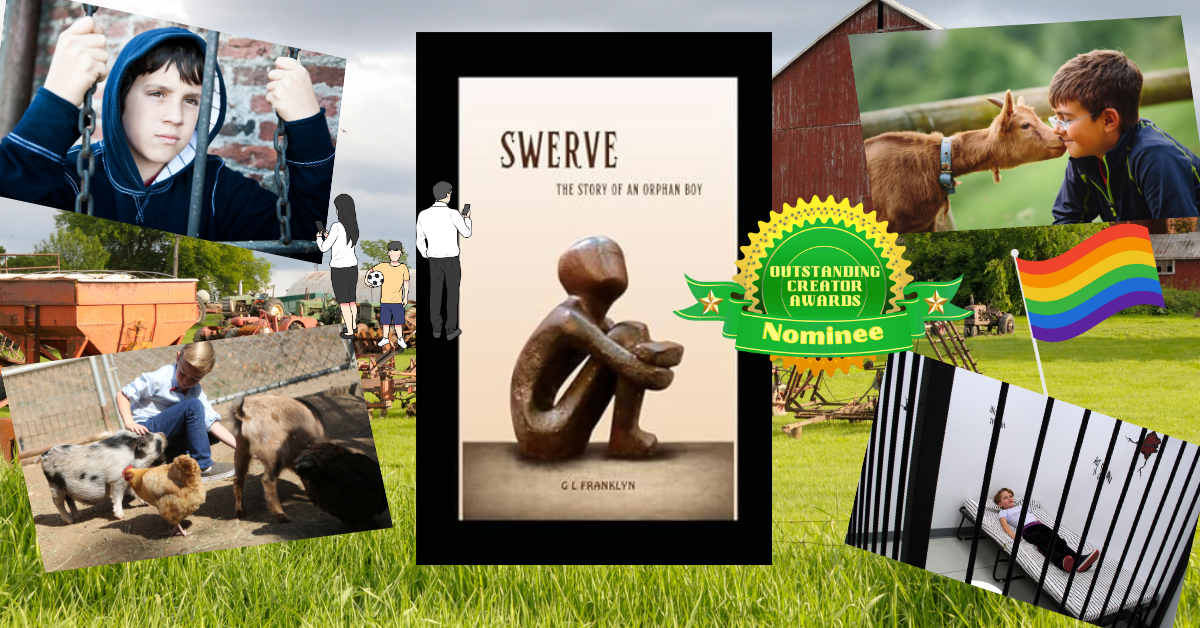 Score: 94/100 (9.4 out of 10)
Swerve: The Story of an Orphan Boy is a riveting, heartbreaking, yet inspiring memoir by G.L. Franklyn. This book follows an orphaned boy who grew up both Catholic and gay in the middle of the 20th century, suffering from all the taboos and stigmas that come with that. This poor boy suffered tremendous physical, emotional, mental, and—perhaps worst of all—sexual abuse from a young age. He was also exploited for free farm labor, ironically similar to another book we read about the foster care system around this time. He says: “I would go on to live, shoulder to shoulder among damaged and unwanted kids.” Perhaps the most tragic thing about all of this is that these types of abuses were so frequent in the foster care system that Franklyn became desensitized to it and expected it. He began to accept that this is just the way that things are. No child should have to live with such meager and dismal expectations. This is not the way that things should be. Every child should feel safe and have somewhere they can call home. We're not exaggerating when we say this: this kid went through more in the first eight years of his life than most people go through in their entire lives! It is absolutely horrendous, tragic, and sad what happened to this kid. And yet... despite all of that, here he is: alive and able to tell the story! We feel blessed and honored to be able to read this, despite the fact that it can be uncomfortable or even agitating to read. The very fact that we felt this is way is a testament to Franklyn's storytelling abilities. Yes, the formatting of this book is unfinished and rough, but the way that the author tells the story is captivating. It takes skills to evoke those types of emotions from your reader. Also, the story of this book is a reminder of how fortunate we are to be alive. Hurt and pain are a part of being alive. Suffering is a part of life. It's a part of the experience. It's a part of our hero's journey. We all have our own unique challenges, some more than others. It's how we face and overcome them that counts. The boy was born into a highly-religious (Catholic) family, but developed an effeminate (we liked to say “flamboyant”) personality that went against their beliefs and expectations. To make him a real boy, he was sent to a military prep school. Along the way, his mother fell in love with another man and essentially left the family to live with him. His father, already frustrated with the boy's effeminate nature and budding homosexuality, also rejects him. In court, the boy is forced to hear why both of his parents don't want him, each with their own motivations and on separate sides. The court sends the boy to, of all places, juvenile detention—essentially a prison—simply because there's nowhere else to keep him. There, the boy was treated like all of the other young prisoners, some of whom were charged with actual, serious crimes. In fact, he finds, the more serious the crimes committed, the higher up on the pecking order that the juveniles are. This is one of the many things that seems to fly in the face of the boy's Catholic upbringing, one that is rigid with its rules, code of ethics, and penalties for disobedience. Ironically, despite religion being one of the banes of his existence, it also helped to arm the boy with a strong sense of morality and honor that he holds throughout the book. Likewise, the abuse he experiences seems to teach him empathy and compassion. We read him say things like: “It bothered me because I couldn’t understand why someone would come along and destroy someone else’s joy like that, just because they could. But then, that’s not how I responded to trauma. I wouldn’t do that to anyone because I was well versed on what it feels like to be on the receiving end of such senseless cruelty.” Also: “Being fair was a core value for me and I think the others could sense it.” Juvenile detention proved to be just one of the many prisons that the boy was forced to live in. Along the way, he was forced to live under the roofs of many foster families, each with their own levels of depravity and ways of abusing him. Perhaps the one that disturbed us the most was Bob, one of his older foster brothers, who frequently forced the boy into sexual acts. Bob is evil, but there's a lot of evil to go around. There's also a foster-mother who prohibits the boy from showering because of some kind of OCD or psychosis she suffers from. He is also blamed and beaten for various things by numerous foster parents. However, probably the experience we found ourselves the most engaged with was the boy's life on a farm, living with a family known as the Macklems. There, he is exploited for free farm labor. This is eerily similar, if not identical to the experiences of Roger Saillant in The Power of Being Seen. As a boy, Roger was also forced to live and work on a farm by the foster care system. However, it almost seems like this experience was the most positive of all of Franklyn's young life as an orphan, and that's saying a lot! He actually seems to see the farm as a rather exciting place, saying: “There were 40 acres, including 2 barns and plenty of old forgotten farming equipment to explore; and, of course, a stable full of Ponies to ride.” He really feels a sense of belonging and at home on the farm, despite its dirtiness and hard work. One of the most beautiful parts of the entire book is when the author describes how the mere smell of the farm made him feel: “Another thing I loved about living on a farm was the smells. The smell of Hay and the smell of Straw are different. The smell of fresh, moist soil. The smell of the mash we fed the Cows was a combination of oats, wheat and corn ground up together. The smell of warm milk as we milked the cows. Even the smell of different animal’s manure. Pony manure doesn’t have much of a smell, but cow manure, as I’m sure you know, has a distinctive and pungent odor that wasn’t altogether unpleasant to me. There is something about all these smells that felt earthy and comforting to me.” The farm gives him a sense of awe and wonder, things that a child should naturally experience—and things that he was deprived of for so long. Now, again, this book is filled to the brim with triggering content including sexual abuse and exploitation. Some of the sexual stuff is quite frequent and graphic. There are some amusing and even funny spots that lighten the mood. For example, the author describes that when he and another person would pee “we used to have sword fights with our streams.” This is a reminder that, despite all that the boy goes through, he is still a boy. And boys will be boys. Check it out on Amazon!  Score: 84/100 (8.4 out of 10)
May I Come to Your Party? is touching children's book about the subject of autism by Grace A. Wolf, illustrated by her older brother, Samuel J. Gross, who has lived with autism for most of his life. The book follows Jimmy, a little boy who loves dinosaurs, drawing, trains, and video games (like many kids). However, unlike most kids, Jimmy is autistic. This affects how he communicates and interacts with others. It also makes him sensitive to lights and loud sounds, which seems strange or even weird to others. Jimmy is a compelling character, in part, because of how introverted he is. He is a daydreamer and has a very big imagination, which he mostly keeps to himself, expressing them in the form of illustrations. You can't help but feel like Jimmy is directly inspired by Samuel Gross (the illustrator) himself. One of Jimmy's classmates, Clara, is having a birthday party. She invites everyone in the class except for Jimmy, believing him to be weird or even scary. This is largely because she doesn't understand autism. This greatly hurts Jimmy, as it would hurt a lot of us. In fact, this story is incredibly familiar and relatable. We all know what it feels like to be rejected or left out. We all know what it feels like to feel different or like we don't fit in. We all know what it feels like to feel like we don't belong. At the same time, it's easy to be angry with or even hate Clara for what seems like a cruel act, but this book doesn't encourage these harsh responses. Clara, like a lot of us, is just afraid of what she doesn't know—what she doesn't understand: the fear of the unknown. This is a natural instinct that most human beings have. This is why we usually surround ourselves with like-minded or similar people. However, a remarkable supporting character named Alice is able to intervene. She is able to talk to and educate Clara about what autism is and how it works. She is able to tell Clara that Jimmy is a human being like everyone else, someone with hopes, dreams, and imagination. It's with this understanding that Clara is able to right her wrong. Jimmy attends her party and the two presumably become good friends afterward. It's a really beautiful and powerful story. While the illustrations aren't the strong-point of this book, we completely understand that they come from a place of passion and love. Samuel L. Gross may not be Rembrandt (yet), but he is clearly trying and getting better. You can say that the humans in the illustrations look a little bit like stick figures or that their heads, in particular, look a little warped. However, the characters and the actions on the page are still distinct, clear, and easy to understand. We would rather have hand-drawn, hand-colored illustrations like this in the book than most AI-generated art. We encourage Samuel Gross to continue to practice and get better at his craft. Everything can get better with time and practice. All in all, this is a powerful story about a very important subject. Check it out on Amazon!  Score: 92+/100 (9.2+ out of 10)
Arizona Way Out West and Wacky: The Play is a fun, educational script for a children's play that seeks to inform the audience about the great state of Arizona! The play is based on the book titled Arizona Way Out and Wacky by Conrad J. Storad and Linda Exley. There are two versions of play: One for grades 2 and 3 One for grades 4 and up Both plays generally concern the ringtails/ringtail cats (the State Mammal of Arizona since 1986), how these ringtails helped the miners of the area to ward off rodents, the bizarre way that the capital (Phoenix) was chosen over Prescott, and some other trivia about the state's history. However, the play for grades 2 and 3 is shorter and less focused on any one specific character (or characters), thus, it isn't necessary for there to be a standout performer in the group (which, believe it or not, tends to be the case with a class of kids). This version of the play usually involves large groups of the kids/performers performing together, particularly the ringtails. This allows for mistakes, errors, and/or forgotten lines to go unnoticed since they can blend into the background and into the group, similar to a choir. It's also less stressful for the kids that way. This version still features the Saguaro Cactus, Cactus Wren, and Tarantula in a featured role, but they're very brief and don't require much memorization. To be honest, we would prefer if designations and directions like “Stage Right” (SR) and “Stage Left” (SL) not be used in this specific case because they tend to be confusing for young people. “Right side” or “Left side” might have been simpler and less confusing for kids, although improper in theatrical terms. It's also a little bit of an eyesore to be reading a script and see “S.R. Ringtails” and “S.L. Ringtails.” We also aren't sure if 2nd and 3rd graders are going to get who a “Prospector” is. However, we're assuming that around the time the students are performing this play, they'll be learning about the prospectors who came to the west in search of gold and silver. “Saguaro Cactus” could just be shortened to “Cactus.” Likewise, “Cactus Wren” could just be shortened to “Wren” or even “Bird.” We know that takes away a little bit from the huge, impressive well of knowledge and information the writer is trying to present, but we're thinking for the sake of young performers. We wouldn't be surprised if the director or parents just crossed out or replaced these things with simpler terms to make them less confusing. Heck, they might even cross out “Tarantula” and just write “Spider.” Thankfully, the writer seemed mindful that the people performing the play would adjust and adapt it as they deemed fit. Performing on stage is stressful enough without the added confusion or unfamiliarity. However, yes, if the teacher or director staging the play takes extra, special care in educating and guiding the kids, it could still work and be a positive, educational experience. There's also a version of the play for grades 4 and up, and it's this version of the play that we weighted the most, elevating this book from about an 8.9 or 9.0 to a 9.2+! The version of the play for grades 4 and up is much more focused on characters and actually has a specific plot. This plot follows a character named Jo (a unisex name chosen because the performer could be either male or female based on which of your kids is best for the role) as she/he is preparing a report on the state of Arizona for school, presumably at the last minute after procrastinating. That sounds familiar! Many can relate. Jo is actually from Nebraska and doesn't seem very interested in Arizona, a very different place all the way across the country that seems to have no relevance to Jo's life. A little frazzled and stressed by the situation, Jo is falling into self-defeating behavior before a miracle comes to their window in the form of two talking Ringtails! These two Ringtails are named Johnny and Jayne. Now, we would've preferred if Johnny and Jayne were given different names, and here's why: you don't want three characters to have names that start with the same letter or sound and have similar lengths. It becomes confusing and easier to mix them up. During rehearsals, you may find Johnny and Jayne reading each other's lines by mistake. Whoever adapts this play could probably change their names to something like Bradley and Ronda or Kevin and Sara. You don't really want Jo, Johnny, Jayne occurring on the same page in close proximity to one another (if you can help it). Anyway, while the previous version of the play was less character focused and more focused on presenting history/trivia/information, this version of the play is much more character focused while still presenting the same history/trivia/information (if not more). This play shines in two key areas: the information itself and the humor. This play is both educational and entertaining! In terms of being educational, we learned a lot! Even though some of us have lived in Arizona or have gone on trips there specifically to learn about conservation, we still learned things from this play! Here's some trivia we picked up on: - Ringtail Cats aren't actually cats (ok, we kinda knew this), they're more closely related to raccoons, which explains their raccoon-like appearance. They were nicknamed “Ringtail Cats”after being adopted as pets by miners after they proved capable of chasing away rodents and protecting the miners' foods. This is actually portrayed in both the 2nd/3rd grade version and the 4th grade and up version of the play. However, this also brings up a minor complaint about the 2nd/3rd grade version as we're shown a Ringtail chasing away a rodent, yet we aren't given much of an explanation for what was happening in that scene. We think the audience will just laugh and get distracted by the big “BOO!” in that scene without understanding why it happened. At least in the 4th grade and up version, the animals explain to Jo why it was so important for the Ringtails to scare the rodents away. - We learned the strange way in which Phoenix was voted the capital of Arizona over Prescott, the original capital. It turns out that one of the people who was voting had a glass eye that accidentally got drunken down by her partner. Self-conscious to leave the home without her glass eye, she refused to vote, thus leading to Phoenix winning. - We learned that Arizona's state flag was actually made by a Colonel Charles Wilfred Harrison after he saw that his Arizona regiment was the only one without an emblem during a rifle competition in Ohio. The “Liberty Blue” at the bottom of the flag reflects the national flag. The sun rays at the bottom represent the year-round sunshine the state gets. Lastly, the star in the middle is copper-colored since Arizona was the leading copper producer in the United States. - We learned that Arizona got involved in the Spanish-American War as a way to prove itself and its allegiance, eventually seeking to gain its statehood. - We learned that the Cactus Wren is the state bird - We learned that Arizona is the sixth most populated state in the USA - We learned that Arizona is divided into three regions: plateau, mountains, and desert. - The cactai can grow 50 feet tall and be 200 years old! We definitely noticed these behemoths when we were there. - We heard more about the indigenous people and their petroglyphs. This was actually one of our main reasons for visiting Arizona in previous years. It's fascinating to think that a lot of these petroglyphs are still without interpretations or translations! - We learned that animals like tarantulas live in the cactuses - We learned that the Grand Canyon is 6,000 feet deep. The writer actually does a very good job at giving younger audiences a perspective on how deep that is. They point to the average height of a teacher and say that it would take 1,125 teachers stacked together to be just as tall as the canyon is deep! Kids often need concrete, tangible examples like this to help them understand information that's so big and grand. Beside from being educational, it's also entertaining, especially when it comes to humor! It's very funny at times, albeit more so for adults (especially Boomers) who'll get the somewhat-aged inside jokes and references. For example, the roadrunner is asked if he'll say “Meep-Meep” but replies, “Legally? No.” Lynda Carter (the original Wonder Woman) is referenced as one of the famous Arizonans, and the younger viewers expect Gal Gadot. Fleetwood Mac is also referenced as one of the famous Arizonans. The narration even says that Fleetwood Mac is a little before the time of the young audience but to ask their parents about them. As a point of interest, Emma Stone and Jo Jonas are also referenced as famous Arizonans. Not every joke or gimmick lands. For example, there's a strangely-ubiquitouos scene in both versions of the play in which a Phantom of the Opera tries to play the organ but pricks their finger on a cactus. While amusing and attention-getting, we're still at a loss for why this scene or this character are in this play. It just seems random. Well, at least it gives another performer a role to play. A lot of the humor does land, especially when it breaks the fourth wall and becomes meta. For example, there's a scene in which a tortoise is moving across the stage and the narration hurries it along because the play needs to transition to the next scene. There's another scene in which the animals basically point out the absurdity of Jo learning from two talking Ringtails instead of just going on the internet and doing research there. They tell him he would have no other way of learning otherwise: “If you ever want to chat about Arizona again, all you have to do is get assigned a school report about Arizona and have your power go out suddenly, and have no way of learning about the state otherwise.” That might've been our favorite part of the book. It's the self-aware humor that did it for us. This plot as a whole really reminded us of Bill & Ted's Excellent Adventure. In fact, the setup is pretty much identical. We know we praised the educational and entertainment value of this play, especially the self-aware humor, but we also wanted to praise one other aspect: the costume design. This book provides a load of helpful information and instructions on how to put together the play from a costume design perspective, everything from putting googly eyes on the head of the Tarantula to constructing binoculars out of two empty toilet paper rolls. It really seems like the writer has thought of everything! They even note that the Tarantula is the hardest costume to take on and off, so the actor should play the fewest other roles (if any). They also talk about times when the teacher/director can participate in guiding the performers on or off the stage, or when they should come on and off the stage. Maybe your students could enjoy performing and learning from this play! Check it out on Amazon! 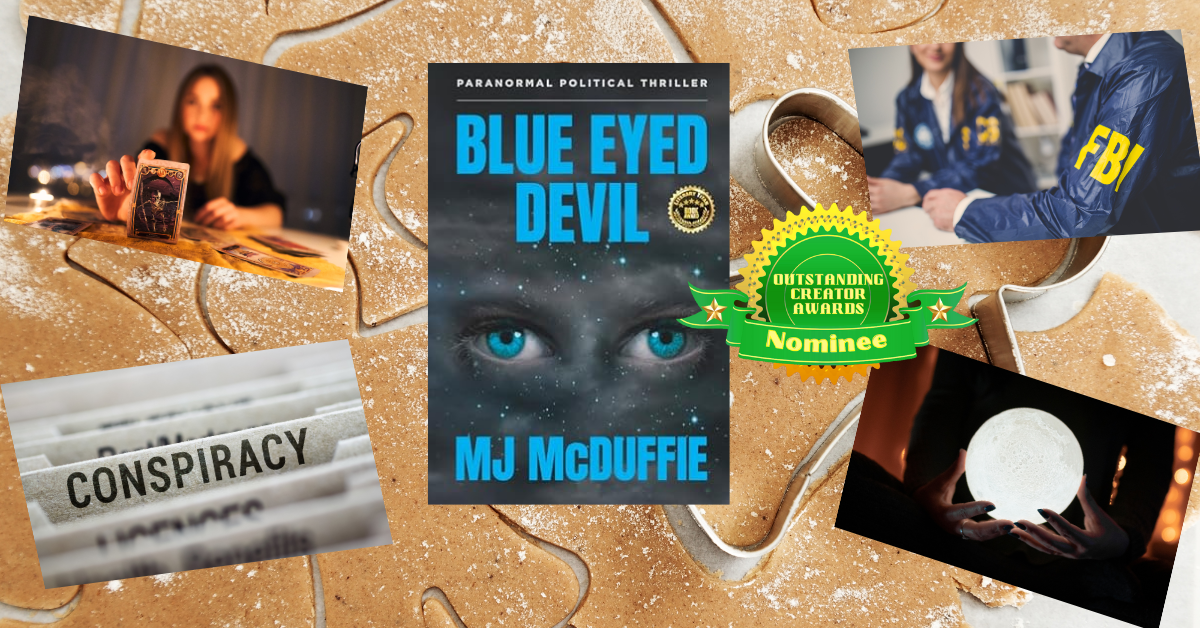 Score: 91+/100 (9.1+ out of 10)
Blue-Eyed Devil by MJ McDuffie is an ambitious multi-genre, multi-layered novel by MJ McDuffie! The book is self-categorized as a “paranormal political thriller” as it involves a psychic/mystic/spiritual medium pursuing the answers behind the global conspiracy that claimed the life of a loved one. What a premise! The book follows Belle Brooks, a budding spiritual medium of Irish descent who lost both her billionaire husband, Sam, and her magical grandmother, Granny Mavis Brooks. Yes, wrap your head around that because it's a mouthful and a mindful! And that's not even the half of it! Apparently, Sam was implicated with some very sketchy stuff including international crime and election interference. Specifically, he was connected with interference in the Irish election and a scheme to interfere in the US elections. He was also connected to black market arms dealers and the cartels—some of the dirtiest dealing on the planet. He is often portrayed as an almost comically-evil person in contrast to the facade he showed Belle, cackling sinisterly like some mustache-twirling vaudevillian tying the damsel to a train track or something. It is discovered that he had loads of fascist propaganda that he supposedly used as motivation to rule the world someday. Belle must wrestle with the revelation that her husband may have never truly loved her and may have actually been an international criminal and power-hungry villain. However, similar to something like Past Imperfect by Joshua Cohen (another private detective-like story), there may be a clear villain, but the problem is must bigger and deeper than just him: a world-wide conspiracy involving a secret society known as the Seven Kings. Of the Seven Kings, one figure seems to stand out in this book: Reid MacAlister, who was a sort of surrogate dad or mentor to Sam—a kingmaker who seems to have loved Sam more than just a pawn in a grand global scheme. Oh, and did we mention that Granny Brooks was magical? Yes, and not only that but she seems to have passed down her gifts to Belle, who is able to act as a sort of psychic or spiritual medium to help get to the bottom of the conspiracy and solve the mystery behind the deaths of her husband and grandmother. The deuteragonist and love interest of this book is Remy Montgomery, an FBI agent who, like Belle, is coping with the pains of loss and a hunger for answers. Remy's wife, Amanda, tragically passed away before the main events of the book. He catches the eye and the suspicion of Belle, who realizes that there's much more to Remy than meets the eye. Through Remy, Belle wrestles with the idea of ever loving and trusting someone again, especially after learning about her husband's criminal activities. Through Belle, Remy hopes to answer some of the same questions and to fill some of the same holes in his heart. So, as you may have inferred, the different genres and tones of this book seem to clash. It's a lot! It's kinda like putting steak in a blender with mixed berries and chocolate. It's kinda like putting tuna and mayonnaise in your peanut butter & jelly sandwich. There's bound to be some wonkiness and wackiness there. The author clearly has a big imagination and a lot of different interests, so it's understandable they'd want to use their book as a canvas to express that. It's not like psychics can't be a part of these types of detective mysteries/thrillers. Though Shawn Spencer in Psych is technically not a psychic in the spiritual sense, he is still treated as having a nigh-supernatural ability to solve crimes. It's actually very interesting and a lot of fun. However, in this book, the spiritual stuff really seems to clash with the grittiness and hard realism of the rest of the book. There's like a cognitive dissonance there. It would be like if you put Gandolf in the middle of something like Forrest Gump or Rocky. Anyway, it always seems like the author is trying to tie one more knot into this Gordian Knot of a plot. The best example of this is the plot/subplot about Granny's secret panacea. Supposedly, Granny discovered and harvested a “spring sage” from native Ireland which could serve as a remedy to Alzheimer's disease and act as a reverse-aging medicine. You could kinda compare it to Granny discovering the fountain of youth. Now, on one hand you could say that this explains why the big-bad-evil-organization would be interested in Belle's family. You could argue that it ties the rest of the plot together. However, you could also argue that it seems tacked-on at the last minute. It is very possible that it was. Why? Well, the author explained something like they got a surge of inspiration from real-world events that allowed them to finish this book around 2020. Well, what happened in 2020? A pandemic and controversy surrounding an election. In this book, you get a controversial reverse-aging panacea and controversy surrounding an election. While the characters talk about it, it really seems like it's in the background. It sometimes feels like these things were squeezed in at the last minute or in a later draft, but the main focus was always supposed to be Belle's relationships with Sam, Remy, and Mavis. The paranormal/spiritual stuff also seems caked onto another, more grounded plot about politicians being corrupt and power-hungry (which shouldn't be a surprise). However, it's a valiant and ambitious effort that seems to be leading into a sequel. Also, when we stepped back and reimagined this as being the origin story of someone like Jean Grey or Psycho Mantis before they were recruited to fight baddies, that really raised the enjoyment factor of this book. Check it out on Amazon! 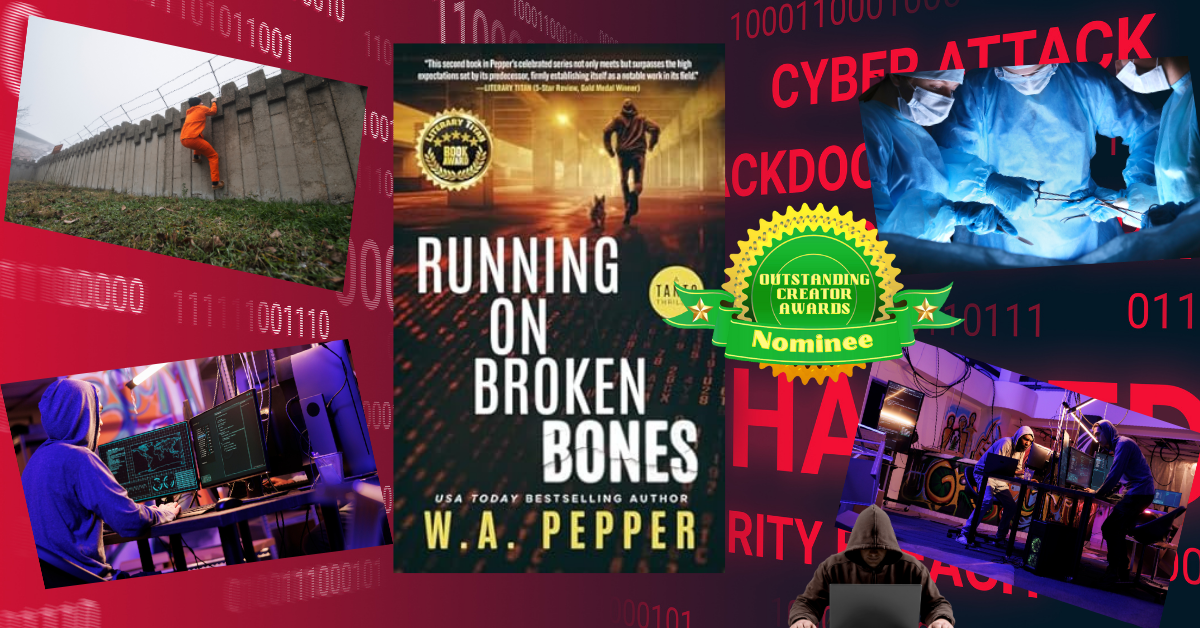 Score: 93+/100 (9.3+ out of 10)
In 2013, Edward Snowden shocked the United States (and the world) with the news that the NSA had been illegally and unconstitutionally spying on people. In being a whistleblower, he became a hero to some and a villain to others—a wanted man, a hunted man, a criminal on the run. He fled to Russia, America's old rival, where he was used for his knowledge of US intelligence and his advanced IT skills. The Tanto Thriller series by W.A. Pepper seems to draw heavy inspiration from this pivotal moment in history and its repercussions pertaining to such things as digital communication, privacy, security, technology, and the freedom of information. Running on Broken Bones by W.A. Pepper is the second installment in the series, continuing to follow the eccentric yet determined hacker and escaped convict, Tanto, as he finds himself on the run from authorities and in the middle of a grand conspiracy. Of course, this grand conspiracy involves the three things that make the world go 'round: power, money, and control. The Federal Government works hand-in-hand with powerful and unscrupulous organizations like the Mercator Agency and Poseidon United to secure the key to power, money, and control: information. The Feds force hackers like Tanto to work for them under the guise of national security in stopping supposed bad actors, many of whom aren't much different than heroes like Tanto, DoGoodR, Lance-A-Little, and Quidlee. Many of these people aren't evil or even bad. Some are well-meaning, virtuous, or—as in the case of DooGoodR—trying to find their “place in the sun.” In this second book in the series, Tanto finds himself on the run from authorities after escaping Hackers' Haven, which ironically proved to be a hellish place for hackers like Tanto as they were controlled, surveilled, brutalized, and tortured by the likes of the warden, Cyfib, and fearsome top-dog in the prison (and Tanto's arch-nemesis), Barca. Tanto escaped, but far from unscathed. He is quite literally on his last leg and his good friend (Quidlee) has been tragically killed. To make matter worse, he has seemingly lost the ability to speak and is experiencing seizures that may be a part of Hackers' Haven's fail-safe program for escaped prisoners. So, the deck seems to be stacked against our hero. His objective after giving the Goggleman the slip is to find allies who can possibly give him safe-haven. To that end, and for sentimental reasons, he seeks out Penny, the beloved sister of Quidlee, his late friend. He believes that Penny herself may be in danger and may be pursued by the evil agencies as collateral for her brother. Now, Penny is both very hot and very much a badass. In fact, she kicks so much ass in so little time that Tanto begins to realize that maybe she doesn't need help or saving after all. In typical, flowery W.A. Pepper speech, Penny is about as vulnerable as Superman is while sitting on the surface of the sun. Penny has keen street smarts, akin to someone like—ironically—Penny from The Big Bang Theory. However, she's actually a bit more like Penny from Inspector Gadget, who might actually be the inspiration behind her name. Like Penny from Inspector Gadget, she seems to be the intelligent one who is two to five steps ahead of everyone else while the male hero wanders like chicken without a head, supposedly saving the day. And that last bit might be the most frustrating thing about the character of Tanto and this particular book. It seems unfocused, stretched-out, and bloated at times. There are over a hundred chapters in this otherwise normal-sized book, which is usually an indication that there's a whole lot going on, some much more consequential than others. Usually, as an author, you create a new chapter when you're going forward in time (like with a day change), going back in time (as in a flashback), changing perspectives, changing focus, changing to a different scene, or changing to a different location. You need to be mindful about doing this too often as the narrative can start to become choppy and disjointed. Also, for the most part, we are still following the same character (Tanto) from the same perspective, so why stop and go so often? It's like being on a car driving down the road at 45 MPH and the driver keeps pumping the brakes every mile. It kinda felt like this book got stuck in the middle and couldn't move forward. It's like it got stuck in one gear or one of the tires blew out, which is a bizarrely fitting analogy considering Tanto's health. There's a real stop and go, squeaky, choppy feel to the pacing and flow of this book. One minute, Tanto is fleeing from the Goggleman. The next minute, Tanto is trying to connect with Penny and getting blown off because of her hurt feelings. The next minute, he's aligning himself with a secret-agent-criminal-janitor named Judson working for his secret-agent-criminal-wife (Cher) who is physically fragile and falling apart (and probably believes in life after love). The next minute, he's meeting some Russian guy aptly-nicknamed Moscow for some unscrupulous, criminal/pseudo-criminal business dealings. The next minute, we're in a flashback about Tanto learning about the Bushido code and trying to protect his kinda-step-mother's property rights from a bicycle-riding slum lord. This somehow leads to all his chickens dying in a fire. Yes, really. The next minute, he's with Judson trying to make a deal with the Russian with a fake/front taco business to advance their master plan, which we assume has something to do with stopping Poseidon and Mercator (and, thus, the main plot). The next minute, we're in a flashback in which he's with Mrs. Lin, his kinda-step-mother, trying to beat the slum lord, Mr. Jedediah McIntosh, in an auction. The next minute, Tanto is in a battle for his life, health, and ability to speak again as he desperately seeks someone who can perform the life-changing surgery that can get him functional. But, wait, there's more! Tanto has PTSD and is constantly hallucinating and having nightmares about Barca watching and assaulting him. But, wait, there's more! Not all the agents are evil or bad. Some of the agents trying to arrest Tanto have their own backstories or alternate motivations. Some are even likable (and hot). So, Tanto is torn about whether or not to tell them the truth about what happened, help them, or just to bide his time. That's... a bit much for one book, don't you think? Especially in a series in which some of these things could've been spaced out so it didn't come across as so clunky. The other source of our contention with this book is the main character, Tanto himself. You'll either love him or you're going to hate him, there's no in between. At least Tanto is a character rather than a blank-slate or a flat person with no personality. Tanto has a ton of personality. It can be charming and funny or it can be grating and annoying. Tanto's defining characteristic is his devotion to the Bushido code, the code followed by the samurai. Now, this is admittedly unique, albeit a bit strange. It almost comes across more like a delusion than anything else. Tanto almost seems like one of those guys who dresses up like a super hero (mask, cape, mantle, and all), then goes out on the actual streets attempting to fight actual crime like a vigilante. It's like that guy who insists that he's a “knight” or a “ninja.” Now, people like that actually exist, but they're far and in between. There are some examples from reality and from fiction. Phoenix Jones from Seattle, Washington was one such guy who dressed up like a super hero and actually tried to fight crime like he was the kid from Kickass. Seifer Almasy from Final Fantasy VIII constantly talked about his “romantic dream” to be a “sorcerer's knight”--something which ultimately caused him to pursue the dark side by serving the evil sorceresses of the game. All of these people and Tanto have two things in common: they're cool and they're crazy. It doesn't help that Tanto doesn't shut up or stop thinking about Bushido and calling himself a “Bushi” like he's an actual samurai who actually lived pre-1868. Tanto even acknowledges that he has “too many bullshit thoughts running through [his] noggin'.” He also calls Judson his “daimyo” over and over again. This is the equivalent of calling a bossy person, “my liege.” Now, at first we thought he was just being coy, snarky, and sarcastic. Tanto is, indeed, a coy, snarky, and sarcastic person, which is part of the appeal (or annoying things) about his character. However, part of us felt like: this dude is SERIOUS, isn't he? Some parts of the narrative support this such as when Tanto says he can't serve more than one master and that his duty is to his daimyo. The other thing we kept thinking was: is all of Tanto's Bushido talk actually advancing the plot or is it just more filler that's slowing it down? Like, you could argue that his sense of honor is what's driving him to be heroic, but... It doesn't take a sense of honor for a good person to do the right thing. You don't have to be a Christian to do good. You don't have to be a samurai or a knight to be noble and honorable. It's a somewhat interesting aspect of his character, yes, but there are times when it just feels bloated, tacked on, and unnecessary. Sometimes, we just wish Tanto would see a situation, analyze it like a normal, relatable person, and say, I'm going to do the right thing because it's the right thing to do or I'm gong to do the logical thing because it's the logical thing to do rather than repeatedly telling us stories about what guys like Miyamoto Musashi would do. Like, we get that he's a bit of a genius with a mind that kinda works like a computer, but c'mon man! Common sense would tell you that when a bad guy is coming for you with better weapons and resources than you, you run and hide! You don't look back with regrets and say, Ugghh... I fled from an unwinnable situation! I've damaged my honor! I've lost myself! I'm disgraced. I can no longer call myself a Silly Caucasian Samurai. Tanto is a hacker and an ex-con. He really should be focused on his skills as a hacker and his plight as an ex-con. All this other stuff just seems extraneous, almost like window dressing. Now, Tanto does have some appealing things about his character, most of all it's his sass. Like we said, Tanto is very sarcastic. He loves to think about and view things in a teasing, mocking, belittling way. For example, he often nicknames people he doesn't like, doesn't trust, or is afraid of “assholes.” Apparently, this is something he did throughout his life since he also gave Mr. McIntosh this moniker. He comes up with other such nicknames for people such as Goggleman and Moscow. He even calls God the “sky daddy” at one point. Probably his funniest sass line is when he says, “Maybe getting shipped to Guantanamo Bay won’t be that bad. And maybe a cayenne pepper enema is a pleasant experience.” He also loves to use the word apparently, which can also be humorous. One thing that's appealing about Tanto and this book is how inspired they seem. By that we mean that the author clearly drew inspiration from multiple other works of fiction, often paying homage to them. This whole series seems partly inspired by Prison Break, an extraordinary TV show. Tanto fits the role of Michael Scofield. DoGoodR fits the role of Lincoln. Quinlee fits the role of Tweener. Lance-A-Little fits the role of Charles Westmoreland/D.B. Cooper (or the Priest from Count of Monte Cristo). Warden CyFib was a lot like Brad Bellick. Barca was a lot like the crime bosses John Abruzzi or Lachero. Poseidon United and Mercator were kinda like The Company. In fact—this can't be a coincidence—the secret villain of the final season of Prison Break happens to be named Poseidon. There are definitely other inspirations for this book, many of which are directly or indirectly referenced. Some of the more obvious references are to Teenage Mutant Ninja Turtles, Forest Gump, Looney Tunes, 007: Casino Royale, Pokemon, Akira Kurosawa films, Dilbert, Breaking Bad, and Darkman. There's even a blink-and-you'll-miss-it reference to the movie Nightcrawler: “Yeah, and maybe you can win the lottery without buying a ticket.” There is a part of us that thinks about this the way that some people view Tarantino: a bit too many homages, references, and general nerdom rather than just relishing in the creator's own originality. Also, like Tarantino, the author seems to have their characters blabber too much rather than getting to the point. Now, going back to the references/homages... some of these make sense and help the narrative. Others don't. For example, where was the author going with the Dilbert references? Was that really necessary to the plot? On the other hand, the Darkman reference makes perfect sense because Tanto draws some comfort from Liam Neeson's character in that movie. Like Neeson, Tanto's body is all but destroyed by evildoers, and he has to make a comeback to right the wrongs that have been done to him and those he loves. Also, the brief Jesse Pinkman/Breaking Bad reference makes some sense in the plot because, like Jesse and Walter White, Tanto is also technically a criminal, albeit one who believes he is doing the right thing. Other references, like that of Wile E. Coyote/Looney Tunes, help us to understand the physical dilemma that the character is in at the time. One thing that W.A. Pepper always demonstrates is his excellence in writing and crafting detailed passages. Some might call it flowery, others might call it visceral. Undoubtedly, he's one of the better pure writers to come our way. Here are some of our favorite passages: “...besides, a hack isn't about talking! it is about taking." “After all, we were tools, and tools without functionality are discarded.” “It is amazing how much more work someone will do when you give them a green rectangular piece of paper with Andrew Jackson on it.” There are also visceral lines like: “As I try to speak, my throat feels like I just swallowed a handful of nails.” Excellent writing and eloquent prose are a staple of W.A. Pepper books, and this is no exception! This almost made us think that maybe Pepper has the potential to be a highly-paid, elite ghost writer. His writing is always top-notch. A lot of the times, what he really seems to wrestle with is taking all of his big, grand ideas and putting them together in a coherent, well-paced narrative that flows naturally and organically from one scene to the next. This series is clearly inspired by great things. It is full of great ideas, interesting characters, and one of the best writers on the market at the helm. Check it out on Amazon! |
Archives
April 2024
Categories |
 RSS Feed