 Score: 94+/100 (9.4+ out of 10)
Thank God It's Monday(?) is a humorous, lighthearted, and enlightening Christian self-help book by Tom Petersen! It also has a distinct lean toward the business genre, making it an interesting look at business from the perspective of a devout Christian. You'd think those two things would be incompatible. The Bible has many verses about the struggles of rich and wealthy people to gain salvation. Many interpret Matthew 6:24 (“No one can serve two masters; for either he will hate the one and love the other, or else he will be loyal to the one and despise the other. You cannot serve God and Mammon”) as meaning that you can't serve both God and money. Some people go so far as to say that money is the root of all evil. Is it though? Mammon isn't necessarily money. Mammon could be an evil entity—a demon or a god of another religion. Mammon could simply represent a “master” other than God, and human beings have made all sorts of those: the Golden Calf of Genesis, idols, celebrities, fame, and fortune. Tax collectors and merchants are often viewed with some disdain in The Bible. There is even a verse in which Jesus says that it's harder for a rich man to enter the kingdom of heaven than it is for a camel to enter the eye of a needle. Yet, the reality is that even the Israelites—God's elect—ran businesses, had a currency, collected taxes, and had an economy. Some of the disciples/apostles ran businesses and at least one was a tax collector. So, money can't be intrinsically evil. In fact, money is necessary in a lot of scenarios. It helps us to provide for ourselves and our loved ones. When a loved one is hurt or injured, it's money that allows us to afford their care. Heck, think about Jesus' story about the Good Samaritan (as discussed in this book). Didn't he offer the inn-keeper money to take care of the robbed and beaten man? Furthermore, God clearly encourages us to work and to commit ourselves to labor. Jesus' own step-dad, Joseph, had a trade. He was a carpenter (some would say a stone mason). Ephesian 4:28 tells us that we should work and made our hands useful to provide for those in need. 1 Timothy 5:8 tells us that we should provide for our households. You could even go all the back to the beginning of Genesis when Creation itself is viewed as work or labor by God himself, so much so that he rests from the work on the seventh day. Adam was also placed in the Garden of Eden to care for (work in it). So, working to obtain something, whether it be money or food, is not intrinsically evil either. In fact, it's necessary in most scenarios. So, this is a book about working, being a businessman, and being a part of the economy while also being a devout Christian and member of the church. Those things don't have to be incompatible or mutually exclusive. You can run on one day and you can lift weights on another. It doesn't make you a bad runner or a bad lifter, it makes you well-rounded and balanced. Remember, Jesus could return tomorrow, but we still have to work and provide for our families as if he may come ten or a hundred years from now. You can still exercise your Christian values and virtues in your every day life, including at work. For example, work can be the proving ground for Jesus' command to love our neighbors and to be good to others, even those who aren't good to us. For example, Peterson talks about the “hard-to-adores” at work. You know the ones. These are the gossipers, the complainers—the people we just can't stand at work. Well, Peterson challenges us (as Jesus would) to be good to them anyway. One of the ways you can do this is by finding common ground. Maybe we both like the same things or have the same interests. One of us was a teacher with a very problematic student who probably hated the teacher. However, the teacher was able to find out that the student loved a particular sport and athlete, so they were able to talk about it with them and find common ground. Now, we have to say: this book is hilarious. In fact, that's probably the best and most enjoyable thing about this book. The author is incredibly clever, coy, snarky, and sarcastic. He has a terrific sense of humor! One of the funniest things about this book is that Tom Peterson doesn't seem to be a very naturally-social or naturally-sociable person. In fact, you can even make the argument that he comes across as antisocial and even self-centered in this book. However, that's kinda the point. Human beings are not perfect. We're not always Christ-like. Yes, that's even true for Christians. In fact, believing you are perfectly Christ-like is a level of ignorance, arrogance, pride, and self-righteousness that actually goes against Christ. You need Jesus. You aren't just instantly-perfect by your own doing. All have sinned and fall short of the glory of God. The author acknowledges that he has “ECE” (“Excessively Covetous Eyesight) which is essentially a level of greed, jealousy, and envy that practically all human beings have. We all want things we can't have (or don't have). However, that's when our faith slaps us on the wrist and reminds us of what God has already blessed us with. Some of our favorite (and often funny) lines from this book are: “If you want to look good, stand next to someone ugly.” “Loyalty programs aren't loyal.” There's also a really humorous part where Peterson describes—perhaps playfully and fictitiously—how he secludes himself at work and during Zoom meetings. It's gold! Check it out on Amazon!
0 Comments
 Score: 89/100 (8.9 out of 10)
The Arsonist is a somewhat-romantic romance and somewhat-thrilling crime thriller by Ken Coulson about a man's struggles to repair his broken marriage, stop a corporate Ponzi-ish scheme, hypocritically stop a workplace sexual harassment scandal, and survive being gored by bulls in the middle of Latin America! At some point, arson is involved in this as Cal decides to burn down his house, but that's neither here or there. Gosh, this book really should've been called Man versus Corporation, Home Wrecker, or I Think I Love My Wife? or something. This novel follows Calvert (“Cal”) Minor, a somewhat-lecherous, somewhat-womanizing businessman who has recently let his wandering eye destroy his relationship with his long-time wife and friend, Beth. He finds a new calling with a corporation called Atlas Holdings, owned by the unscrupulous CEO Hank Henleman, a man who is even more immoral and unethical than Cal is. Hank is such a terrible person that he even hopes to capitalize on the 9/11 attacks and climate crisis to fill his own pockets. He also happens to be a bit handsy, akin to Cal. Cal is aware that his boss is probably evil and possibly working with mafioso mercenaries, but he also needs a job (and a need to belong). Along the way, he teases an affair with the voluptuous, beautiful, and very hot blonde bombshell who works the front desk, Sarah Quinn. Sarah is definitely a candidate for “Hottest Character!” Cal's sexual fantasies about her are frequent, detailed, vivid, and quite a bit wild. There's one line in which Cal imagines having oral sex and “her feminine musk mixed with the smell of coconut and rose water.” Well... this is erotica now, isn't it? So, here's what we'll say about this book: it is VERY fun and surprisingly interesting, but it's incredibly unfocused. It's like the author couldn't decide on what genre they wanted to write in or what book they wanted to write, so they decided to write in every genre that came to mind and to combine the plots of multiple books into one. So, is this supposed to be a book about a man's torn relationship with his wife and his extramarital affairs? Is this supposed to be a book in which a man realizes that his side-chick is his true love? Is this supposed to be a book about corporate greed and corruption manifested by Hank? Is this supposed to be a book about mafioso mercenaries led by Arik and John? Or is this supposed to be a book about a man exploring a new experience surviving racing with literal bulls? Or is this supposed to be a story about an arsonist committing... I don't know... arson? We actually got a story about an arsonist last year. It was called Prometheus' Gift by John Sangster in which we got a rather complex deep-dive into the life and mindset of the arsonist. While Cal's plight is somewhat relatable, it doesn't seem to justify him wanting to literally burn everything to the ground. And that brings us to another point: Cal is a terrible person. He may not be as terrible as Hank, Arik, or John, but he comes across as incredibly self-destructive, self-sabotaging, and unlikable. How are we supposed to cheer for this guy when everything bad that happens to him is literally his fault? At least that's what we'd normally say about a character like Cal. Yet, somehow, we still found ourselves fascinated by Cal's alien thought-process. It's like watching a Karen go crazy on a store clerk or watching a car crash in slow motion—it's bizarrely fascinating! Check it out on Amazon!  Score: 95+/100 (9.5+ out of 10)
Tap Dancing on Everest is the remarkable true-story of Mimi Zieman who, as a third-year medical student in 1988, became the medic for a historic, unprecedented, and unfathomably perilous climb up Mount Everest. The climbing mission—dubbed the Everest 88—featured Stephen Venables, Robert Anderson, Edward Webster (“Ed”), Joseph Blackburn (“Jo”), Paul Anderson as the lead, and Mimi as the only woman and sole medic. The mission was to scale Everest on its least-trekked and most dangerous route, its Kangshung Face, often referred to as the “forgotten” or “East-facing” route. It was a route that was only traversed one other time in recorded history and under more ideal circumstances. However, the team of the Everest 88 attempted to do it with a relatively small team, no Sherpa escort, no supplemental oxygen, and virtually no hope for rescue. On the precipice at all times, Mimi finds herself with “nowhere to hide and no way to quit.” And this is the frightening, compelling, and awe-inspiring situation that readers of this book will find themselves in! Not long into this book, we already know that the stakes are as high as they come. Half of the expeditionary team has gone missing, separated from the other half with no sign of life. Among the missing are Stephen, Robert, and Ed, a few of whom who have formed a powerful and even pseudo-romantic/intimate connection with Mimi. Mimi must cope with the fact that she might never see them again, or that they may be dying alone and helpless on the mountain of dreams (and horrors). This is a journey in which characters—real-life people—have lost numerous fingers and toes to frostbite. Death waits around every corner and with every step. However, with all this build-up and potentially huge scope, this is really the story of Mimi—the medic, the soon-to-be doctor, the dancer, the daughter, the woman, the person. This is a very deeply personal story. It follows the thinking that we only know who we really are when the prospect of death awaits us. The backstory behind Mimi, her family, her twisting-turning life, and her motivations behind climbing Everest are almost as compelling as the climbing of the mountain itself. Mimi and her family are Jewish immigrants, persecuted and marginalized minorities who could only find hope in being as valuable to others as possible (to stay housed and alive). Mimi's father is a Holocaust survivor. She and her family were in survival mode throughout the 70s. Everything had to be safe, small (narrow), and stable. Mimi seems to have become a bit of a people-pleaser and a perfectionist as a result; and as a result of that, she also developed a few psychological issues. Perhaps the one issue that stood out to us the most was her eating disorder. We think a lot of readers might miss it, but it's something that really spoke to us. We're not psychologists, but we've had issues of our own that are similar to this (and have read about it in other books this season). Mimi, in the earlier portions of her life, seems to have had a form of bulimia known as exercise bulimia. This is less-acknowledged form of bulimia in which a person doesn't purge but rather compensates for overeating by excessively exercising. Despite scenes like this being troubling and disturbing, they help us to better understand why Mimi—someone with a seemingly bright future—would attempt to climb Everest on what seems like an insane suicide mission. Mimi was able to use her drive to overachieve and overexercise to become a dancer and, eventually, a hiker and a rock climber. You could even argue that she was able to use her masochism toward the goal of climbing Everest. There are some other humanizing and relatable aspects of this book. For example, Mimi's need to use a tampon and to use the restroom in a bottle during the arduous climb are detailed. You also get to read about her interesting and sometimes hilarious interactions with the locals, particularly in Tibet. For example, her team scares a local family and drives the mother into a frenzy when one of them uses flash photography. There's also a scene in which Mimi needs to go to the edge of the town in order to use the only restroom but can't make it there in the middle of night, having to do her business in the barn, then is startled by the incessant, hysterical chanting of the lady of the house. It's almost like a horror movie scene! All in all, this is a really fascinating read. If anything, it's an example of how new doors and new windows open in our lives, often unexpectedly. Mimi endured a lot of down moments in her life that eventually led to exciting new things. Like Mimi says: "If Dad hadn’t forgotten to fill out the financial aid form for my favorite college, I wouldn’t have gone to McGill. If I hadn’t gone to McGill, I wouldn’t have seen the RMBL poster. If I hadn’t gone to RMBL, I wouldn’t have seen the slide show about Tibet. If Tibet wasn’t closed to foreigners, I wouldn’t have gone hiking in Nepal. If my first trek around Annapurna hadn’t been so cheap, I wouldn’t have gone to Everest Base Camp. If Dan hadn’t invited Irene and me to the Everest party, I wouldn’t have met Robert. If Robert hadn’t been so persistent, we wouldn’t have grown to care for each other. If the dean hadn’t granted me time off, I wouldn’t be here.” There are some other examples of good writing in here. For example: “All I wanted at that moment was the warmth of his arm around me in this cold cocoon.” Check it out on Amazon!  Score: 94+/100 (9.4+ out of 10)
All adventures start with a dream. All fantasies start with imagination. Where will you dreams and fantasies take you? And are you willing to pay the price to fulfill them? Secrets of the Sealed Forest by J.T. Tenera is a meta novel that blends aspects of gamelit, sci-fi, and action/adventure storytelling. The novel follows a gamer, streamer, and internet personality (influencer) named Joseph who lives, eat, sleeps, and breathes video games, so much so that he dreams about being in one! Realizing that living in a video game world is probably unfeasible, Joseph does the next best thing: try to be the biggest, baddest, most famous gamer on the internet! Unfortunately, his ego and quest for internet stardom get the best of him as it causes him to jump at the opportunity to demo an unreleased, hotly-anticipated game called Call of Echo 3: True Honor (implied to be a blend of Call of Duty, Medal of Honor, and Baldur's Gate III). His goal becomes to play and stream the game before anyone else in the Twitch & YouTube streaming communities can—to be the one to have the big scoop. Alongside his best-friend, Eric, he accepts an invite to come to a tropical island littered with inventions and technology created by the man who sent the invite, Dr. Benjamin Thessit (often just called “Dr. Ben”). By the way, Dr. Ben insists that they not tell anyone, which causes Joseph and Eric—like the geniuses they are—to not tell their parents or families where they're heading. Anyway, as you might have guessed, this “gaming” invitation isn't quite what it seems. In fact, this isn't quite virtual reality. MAGIC is real, and so are the characters! Dr. Ben springs a challenge on Joseph and Eric to find a magical stone that was taken by a colleague, leading into an action-packed adventure! Joseph and Eric find themselves on a “side-quest” to recover the magical artifact, all the while unlocking the literal and metaphorical magic within themselves! Secrets of the Sealed Forest will go down as one of the shining lights and surprises of the season. It is a book that really spoke to us since it dealt with things that we're familiar with: video games, influencers, Twitch streamers, content creation, etc. Something we really loved about the book is how it pays tribute to gaming and gaming history. There are numerous homages that made us smile, including:
It's also quite entertaining and humorous that even Joseph has some beef with another internet personality named Clyde Foristen, a pompous rich boy who probably has all his games and consoles paid for by his parents. It made us think about how YouTubers in real life will develop beefs and become the talk of the internet rumor mills because of it. The writing in this book is also quite eloquent at times. For example, the quote: “...sometimes it's better to follow the flow of fate rather than to fight its current.” One thing this book had against it was its pacing. It was a little bit too long and dragged in its last half. In fact, the setup itself was probably more interesting and better executed than the adventure. Usually, the opposite is true. It was also missing a gorgeous, beautiful, compelling female character. A little feminine touch would've been nice to see in a book like this. But all in all, it was an enjoyable experience. Check it out on Amazon!  Score: 90/100 (9.0 out of 10)
Where Are You, Alfie? was one of the the sweetest and most heartwarming children's books to come our way last year! An entire community banded together to find one adorable pup who went missing, pulling all their resources to make the magical reunion happen. Where Are You, Alfie? Coloring & Activity Book now allows young readers to directly engage with this beautiful story of teamwork, camaraderie, and hoping against all hope. The book provides over 20 pages of coloring pages and activities of various kinds, from crossword puzzles to mazes! Now, one concern that we had was that Anthony Richichi's original art may not translate too well to coloring book format. The reason we had that concern (which turned out, in our opinion, to be somewhat accurate) is that Richichi tends to draw figures from a distance with the lines of objects closer together. This was especially noticeable in the original book because the scope of the book was so great, spanning events across the city and crossing state lines. Ultimately, this meant that a lot of the figures, people, and objects were smaller and further away from the perspective of the reader. In other words, this doesn't leave much room for actually coloring, except with maybe a very fine color pencil. You can't really go after this coloring book with a crayon. Usually, with a children's coloring book, you want at least one very large object somewhere in the middle of the book. Interestingly, Richichi's brother, Dr. Joe Richichi, published a coloring book of his own called Colorful Creatures which seemed to better follow this template (though it struggled in other ways). With that said, this book isn't just a coloring book. The activity pages pleasantly surprised us with their cleverness and ingenuity. Some of these activities are unique to the story of the book. For example, there's a line-maze to help Alfie to join other dogs who are across a lawn and behind a fence, calling out to him. There's another clever activity that has you count the people and drones that are out looking for Alfie. Both of these activities really make you feel like you're helping Alfie and the people looking for Alfie. Probably our favorite activity in this book is the town meeting scene in which the reader is invited to find and identify various objects in and around the crowd. Activity books are great tools to help children (and even adults) to exercise their cognitive abilities, testing things like recognition and following directions. Check it out on Amazon!  Score: 95/100 (9.5 out of 10)
Time and time again, Tuula Pere wows us with her incredibly deep, complex, and intricate children's books—ones that subvert expectations and break the mold of what a children's book can and can't be. She is that great of an author. Time and time again, Francis the Fox, one of Pere's most iconic characters, proves why he was named “Best Character” and “Best Villain” in previous contests. He is that compelling and interesting as a character. Now, is Francis the Fox a good guy? NO. Is he a conventional protagonist? NO. Francis is a gray character who leans toward the dark side, something that is very rare in a children's book. He is, at best, an antihero and, at worse, a villain. However, that doesn't mean that children's can't learn important lessons from reading books about him. See, Francis the Fox is an example of how NOT to be—an anti-role-model, in a sense. He is an example of what happens when greed, hubris, pride, and arrogance rule a person's conscience. He is a megalomaniacal, Machiavellian character who wants to show the world how great, grand, and powerful he is. In a sense, he is what happens when egos and ambitions go uninhibited and grow out of control. We can lose sight of the good things that are already in front of us. With that said, The Fox's Palace follows Francis as he schemes a new way to achieve greatness and to improve his public perception, including the way that his family in another town perceive his supposed accomplishments. Francis has been caught in a web of lies, telling everyone back home (including his mother from the first book) that he has made it big and now lives a huge, impressive home. The problem is, the opposite is true. He has failed numerous times, including attempting to run the city in the last book (The Fox's City) and being caught in criminal activities. In the third book, The Fox's Tower, we also saw how ruthless, unscrupulous, self-destructive, and what a failure Francis could be. To combat his conundrum and chase his unchasable dreams, Francis concocts a plan to get a half-blind badger, Barry the Badger, to sign away his large beach side estate, which he uses as a boat house to sell and rent aquatic equipment. Along the way, Francis behaves and acts suspiciously, measuring everything on the estate to the most minute detail. It's at that point that we noticed how much more detailed this book was in comparison to the other two. The illustrations by Andrea Alemanno are, once again, outstanding! In fact, they're even better than usual. Going back to the story... Francis's unscrupulous, underhanded activities become criminal and catch the attentions of Mayor William the Wolf and the police department. Unlike The Fox's Tower, this book has the benefit of having a much less abrupt and somewhat dissatisfying ending. The Fox's Palace allows Francis to realize the error of his ways and learn from his mistakes, although we found ourselves torn about whether or not Francis really deserves a second or third chance. At what point do you become irredeemably bad? Francis is not pure evil. He is a lot of us at our worst. We all have dreams, hopes, and ambitions. However, some people (like Francis) let those things get out of hand and let their egos grow out of control. This book, like the rest of the series, does a good job at teaching how self-destructive and self-sabotaging this can be. Rather than getting us closer to our goals, being ruthless, cheating, and lying ends up hurting us in the long run. Check it out on Amazon!  Score: 94/100 (9.4 out of 10)
Fight some Nazis! Explore some secret tunnels! Solve some cryptic prophecies! Save those children! Benjamin Weiss and the Divine Prophecy by J.A. Robertson surprised us with just how thrilling and exciting it got! This isn't your run of a mill YA/middle-grade detective mystery. There are some heavy, weighty themes at play in this book, ones that resonate with ongoing situations in the Middle East. Benjamin Weiss (usually just called “Ben”) is an often-bullied Jewish high school student with a unique gift: the ability to have prophetic dreams similar to Joseph and Daniel in Judeo-Christian scriptures. However, he wrestles to comprehend and interpret these dreams. Helping him on his hero's journey are Grady, his best friend, Miriam, his girlfriend, and Rabbi Greenblatt, his mentor. Ben, Grady, Miriam, and Greenblatt live in a community that has been ravished for decades by mysterious, unsolved disappearances, specifically that of 19 children. The baffled police often dismiss tips due to the number of conspiracy theories that have come their way. Everyone lives in fear of when the next disappearance might occur. The only leads that Ben and company seem to have are Ben's confusing dreams and a series of Nostradamus-like prophecies by a Dr. Grimgory made 300+ years before. They are also able to follow the pattern of disappearances to deduce that the next person to go missing will be a girl who fits a very specific profile. The race is on to protect this unique person, stop the alleged perpetrators, and find those who've gone missing in the past! It's a very exciting premise! There are a lot of nuances in this book that may go over the heads of younger readers, but they're important to mention nonetheless. The book doesn't shy away from the tragic and disturbing history of antisemitism, particularly of the Nazis around World War II. This book is a reminder that people still exist who dislike or even hate Jews and that Jews are still often the unfortunate targets and victims of violence. Antisemitism is not a thing of the past. It's not ancient history. It hasn't disappeared. In fact, people suffer from it every day. This book is an important reminder of why we should stand by the mantra “Never Again!” as in, we can never allow a Holocaust to happen again. It is also a reminder of why Jews and Israel must fight and do everything in their power to protect themselves from numerous enemies who threaten their existence. With all that out of the way, we have to say that the first quarter of this book did bore us a little. It was slow and had pacing issues. It seemed to be bogged down by the author attempting to do/show too much. For example, did Rabbi Greenblatt really have to be such a big part of this book? He seems like a character who could've been trimmed out to save time. There were also way too many villain like Shane and Strong Voice involved in this elaborate, over-the-top, decades-long conspiracy. We get it, the author wanted to show that evil ideologies can transcend and carry over for generations, but it got a bit much. The people we really cared about was the trio of Ben, Miriam, and Grady. We were surprised by how much Miriam in particular endeared herself to us as a character. She is a really pleasant person who stands by Ben even when it seems like he's going a little crazy. Similarly, Grady proves to be a great friend. There was one really weak character moment for Ben and Grady in which Grady fell on his bike into a crevice and Ben didn't seem to care at all. A quick “Grady, nooooooo!” or “Grady, are you ok?!” would've sufficed. Instead, Ben just shrugged it off and asked how he could get down there too. Another missed opportunity is simply that the person who ultimately got kidnapped/went missing was the wrong person in our opinion. It was a character who wasn't built up to be rescued, or whom we hadn't emotionally connected with as much as the alternative. Anyway, we came away from this book feeling mostly entertained and satisfied. Could it have been better with a few tweaks? Yes. However, it mostly does what it does well. Although we don't get to know her much, “18” (Gretchen) is a candidate for “Hottest Character.” Also, there is one hilarious bit in which the author shoehorns in Benjamin having a deformed hand just when it's convenient. That made us a chuckle a bit. You can check it out on Amazon!  Score: 95+/100 (9.5+ out of 10)
Deserts to Mountain Tops is a deep, compelling, and emotionally-charged collection of personal stories by Jessica Buchanan and a plethora of talented, successful, and inspirational contributors! They champion the idea of self-love and self-acceptance. Despite common, overlapping themes and subject matters, every single one of these personal stories is powerful, painful, beautiful, brilliant, and unique in its own way—just like the writers themselves. Now, we have to get this out of the way real quick: this book is full of potentially triggering content. However, we are so glad that this book chose to cover certain subjects that don't get talked about enough. Most of all, we are so glad that there is a book out there that discusses the painful, taboo, yet awfully common plague of eating and body-image disorders. So many of us have struggled with this, personally, at one time or another. There are thousands or even millions of people still struggling with it, bombarded with images of perfect people on Instagram, TikTok, and TV. It doesn't help that there's a fast food restaurant or convenience store on every corner and a diet book for every Benjamin in your bank account. We are surrounded by temptations, and the greatest temptation in the middle of all of this is the temptation to hate yourself and your body. Yet... it's almost as if no one wants to talk about or even acknowledge it. It's like an elephant in the room. Well, you can't solve a problem if you ignore it and never acknowledge it. You can't acknowledge the problem if it's buried, secret, kept hidden, and shrouded in mystery and darkness. Well, the writers in Deserts to Mountain Tops are courageous and brave enough to pull the curtains back and acknowledge the elephant in the room. They're willing to talk about their own personal struggles—their battles, their wars. Not only is that commendable and admirable, but it's also fascinating and inspirational. Jessica Buchanan introduces us to the figurative “desert of disordered eating” and the dark cloud of self-hate/self-abandonment that reverberate in stories throughout the book. Contributor Michelle Ihry discusses her struggles with a mysterious illness that turns out to be Lyme disease. Similar to Growth by Karen DeBonis, this is a story about how our inflictions—as big, scary, and mysterious as they may be—often have explanations and solutions. We just have to keep seeking answers and never taking no for an answer. Don't sit in complacency and denial if you know something is wrong. Seek help! Seek out experts! Don't suffer in solitude and silence. Talk and listen to others who've been where you've been and have suffered as you've suffered. Emily Cartwright tells the haunting story of her obsession with excessively exercising to burn the most calories and lose the most weight. Similar to Dr. Mimi Zieman from Tap Dancing on Everest, it could be argued that Cartwright suffered from exercise bulimia, a form of bulimia in which the sufferer excessively exercises rather than purges to compensate for overeating. One of the best parts of this book is when Cartwright's feet were heavily blistered and even injured from excessive running, and rather than being concerned for the health of her feet, she was more upset that she didn't reach her goal of running at least 17 miles that day. She was literally destroying and punishing herself. We can't help but feel like we've been in her shoes: we've been there and done that. It's a frighteningly familiar feeling. Tracy Interlandi gave us one of the most interesting of all the stories as it really put into perspective how people can minimize us and focus on one thing that we've done or that happened to us, forgetting that we're a complex, diverse, dynamic, and multi-layered person. In this story, Interlandi was the tragic victim of a savage assault by multiple people. Despite being an accomplished and passionate dancer, the assault became all that anyone knew or remembered her for—“Tracy The Dancer was replaced with The Waitress Who Was Attacked.” She longs to be defined by more than her one bad day. This story says a lot about how we're more than the sum of our problems. We're not defined by our problems. We are so much more. Angelique Velez, who seems to describe a body-image disorder (or, at the very least, an insecurity about how she looked), describes the beauty that came out of that struggle. Velez was able to capitalize on her previous obsession to look good, gaining a passion for cosmetics (makeup), even founding a successful cosmetics business that we presume thrives to this day! Delia Sullivan, similar to Sandy Evenson in The Woo Woo Way, discusses the concept of chakras, specifically what Sullivan calls the “heart chakra.” To put this into familiar terms, a house is only as strong as its foundation, and the heart chakra is the figurative foundation of a person. If you hate yourself, refuse to love yourself, and neglect your emotional well-being, how do you expect your body and mind to function? There are some beautiful lines in this section: “The ink flowed effortlessly, like gentle whispers to my younger self” “Live with the broken pieces, and the unbroken will grow bigger and softer with more vigor" Stacia Bissell discusses something that's very familiar to one of us: a traumatic brain injury suffered from a cycling accident. This TBI gave her a number of difficulties including stuttering, dyslexic-like symptoms, extreme noise & light sensitivities, ringing of the ears, and other cognitive challenges. However, she was able to overcome these issues, refusing to accept that she would only be defined by them and that her life's path would be dictated by them. Bissell also gives us one of the book's most beautiful passages: “...to be the roaring campfire I am meant to be rather than the flickering candle flame I was becoming. The fragments of glass will be colorful, and shimmer brightly. They will be reflective of the collective light that represents the interesting twists and turns to my life that have made me who I am. My brain is still injured, and I’ll always have to manage it wisely, but there’s nothing wrong with my heart.” Julie Larkin's story was arguably the most interesting and fun to read, despite the fact that it was probably the most abrasive. Larkin's story concerns how living only to please people can cost us our selves. It also demonstrates how disgustingly superficial the world is. When we're perceived to be beautiful, fit, skinny, and perfect, people treat us differently. It can be humorous and comical at first, but it goes to show how skin-deep society's perceptions of us can be. And society's perceptions are fickle: they change. The same people who were cheering for us and kissing our butts yesterday could be stabbing us in the back and throwing us under the bus the next day. The other thing we liked about this particular story is how we could relate to Larkin's experience with loose and saggy skin (and possibly stretch marks). These are things that people who lose a lot of weight have to deal with, and almost no one talks about or acknowledges it. It can be very discouraging to lose a lot of weight and still be left with literal scars of it. Larkin calls this “sagging secrets of shame.” Another amazing part of this story is that we get two sides of Larkin's conscience: “Shitty Julie” and “Sacred Julie.” Shitty Julie is always telling her how she has failed because she has eaten too much or gained weight. Sacred Julie reminds her that she should be proud of who she is and to love herself. Courtney Whitelock, a twin, gives us this beautiful passage that seems to bring this book full-circle: “I had no idea that naming my daughter Grace would be as significant as it is. I will forever look into her eyes and see a desert, a mountain, and the courage to conquer them both, now and forevermore.” Check it out on Amazon! 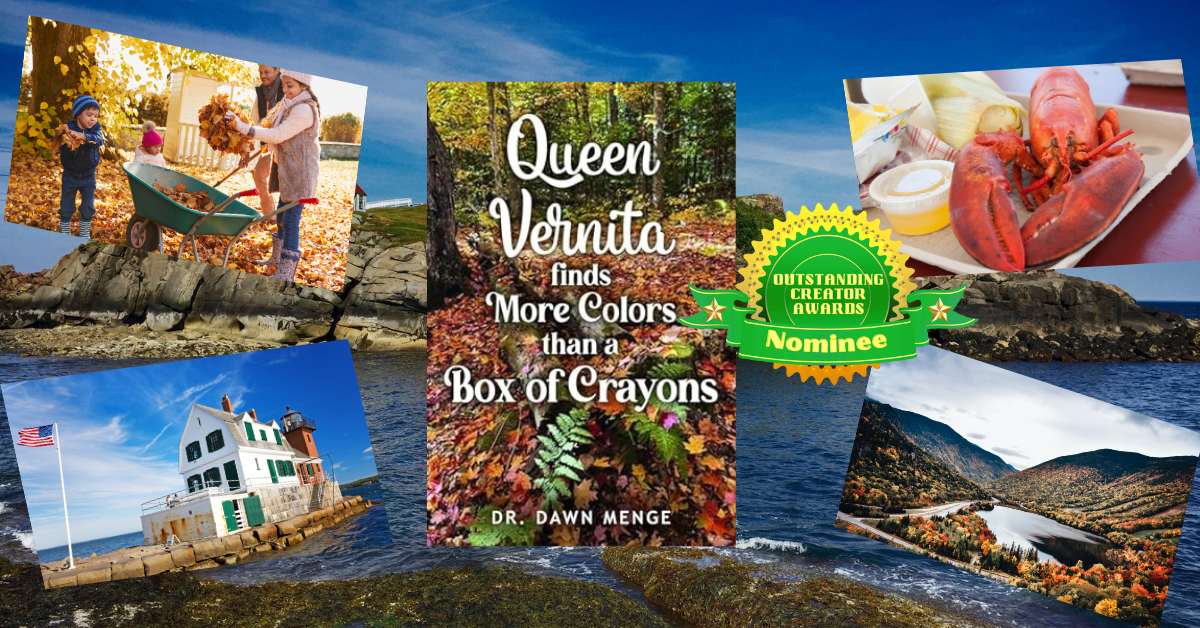 Score: 88+/100 (8.8+ out of 10)
Welcome to a section of the Land of Quails known as New England! Here we rejoin Queen Vernita, the titular protagonist of Queen Vernita and the Land of Little Rain, as she commits to spending several months in this incredible and very different region, meeting new people, trying new things, and learning about all sorts of flora and fauna. If you're expecting a typical plot-driven or even character-driven story, this probably isn't the book for you. If you're into that sort of thing, check out the author's other books: Dragon's Breath and the worthy sequel, Precious the Baby Dragon. This just isn't that sort of book. We think this book might best be described as an experiential novella. It's a short book about a foreigner/relative outsider being introduced to an unfamiliar place, getting to know new people and new things. We think we asked this before, but... who really is Queen Vernita? Is she an actual royal queen or is her name just “Queen” like Queen Latifa? We ask because it kinda changes the plot and a bit of our feelings about the character. If she actually is a queen in the sense of being royalty, it makes a bit more sense. Assuming she is a queen, Vernita proves to be a loving ruler who—rather than sitting her high-tower giving orders—actually gets down and dirty with her people. She lives among them and learns about them. However, this also begs the question... so who's ruling Vernita's kingdom? She's over here gallivanting and traveling all the time... who's making the executives decisions and tending to matters of the state? Does she have a viceroy or grand vizier tending to these things? Is she married? Is there a king somewhere running the day-to-day operations? Or is this a constitutional monarchy in which the queen really doesn't have to do much because a prime minister and/or a democratic government runs things? We kinda wish we knew so we wouldn't feel like Vernita wasn't fooling around and wasting her time while other sensitive, important matters are going unattended to in her kingdom. It really does seem like it. It kinda seems like Queen Vernita isn't trying to advance a plot or serve a specific purpose. In that sense, she's a bit of a passive protagonist, albeit one who still participates in the more mundane activities happening in the book. Speaking of those activities, they form the core of the book. Queen Vernita isn't about shaking things up. She's isn't about changing the game. She isn't about forcing an agenda or insisting on her own way. No. Actually, she's about leaving things the way that they are and appreciating them for how they are. That's something we can respect and appreciate about her character. Throughout this book, Vernita travels to the Rockland Breakwater Lighthouse, learning the history and significance of it. She enjoys, rakes, and bags many of the autumn leaves of October. She visits a garden full of different trolls. Yes, really! However, the story that we enjoyed the most in this book was probably Vernita going lobster hunting. There's something about it that was extra engaging. Maybe we were just hungry, but that particular story made us crave lobster! It's also kinda interesting to read how naive Vernita is about these creatures. Remember, she's not from here, she's a foreigner. So, she has trouble telling the difference between the lobsters and crabs. Seeing the illustrations in a few other books this season has really made us appreciate the art/illustrations in this Queen Vernita series. No, they're not extraordinary. It's not going to hang in the Louvre, but you can tell that the author/illustrator put a lot of time and effort into it. At the very least you could say that it's colorful. You can even see the lines and strokes that the illustrator took in creating this. And some of these illustrations are actually very detailed! For example, there's a scene in which a whole bunch of people in a restaurant are eating lobster. Each and every character has a different outfit on. You can even see the texture of their hair. This book does have a few issues in terms of grammar. For one, a comma is missing almost every time that Queen Vernita or another character is addressed. Missing commas have been an issue in this series and the Dragon's Breath series. However, it's nothing major. Honestly, the main issue with this book is how choppy it is. It almost reads more like a list than a story. One moment/month, Vernita is doing one thing; the next moment/month, Vernita is doing another thing. There really doesn't seem to be a rhyme, reason, or direction to any of this. It's just... there. It just... happens. There's no antagonist. There's no villain. There's no problem or conflict other than a brief mention about protecting the environment and not polluting. So that seems to be our main issue with this book and this series. Where's the tension? Where's the suspense? Where's the conflict? It often seems like Vernita is going from place to place and doing one thing after another. None of the people she meets, except for maybe Trisha, is memorable or stands out. They're more like NPCs. They're just... there. Another thing we kept wondering about is how does Queen Vernita realistically fit into the over-arching story of the Land of Quails in which King Teddy and Queen Giggles (from Dragon's Breath and Precious the Baby Dragon) also live. In fact, Queen Vernita is even mentioned in that other series. However, aside from the trolls (which we aren't even sure are actual, fantasy trolls and not just straw/rock figures), New England or even the Land of Rain don't seem to fit with the portrayal of the Land of Quails in the Dragon's Breath series. New England and the Land of Little Rain are very modern. The people there wear modern clothes. They use modern tools and appliances to, for example, cook lobsters with. In contrast, the people in the Dragon's Breath series clearly live in a medieval-fantasy environment in which people use flames and lamps for light. So... is Vernita a time-traveler? Is she immortal? Like, did she survive for 700 years in medieval-fantasy Europe (a land in which dragons live) and then visit New England in the 1900s/2000s? Maybe we're overthinking this, but we do pay attention to details like that. Maybe you can figure it out. Check it out on Amazon! 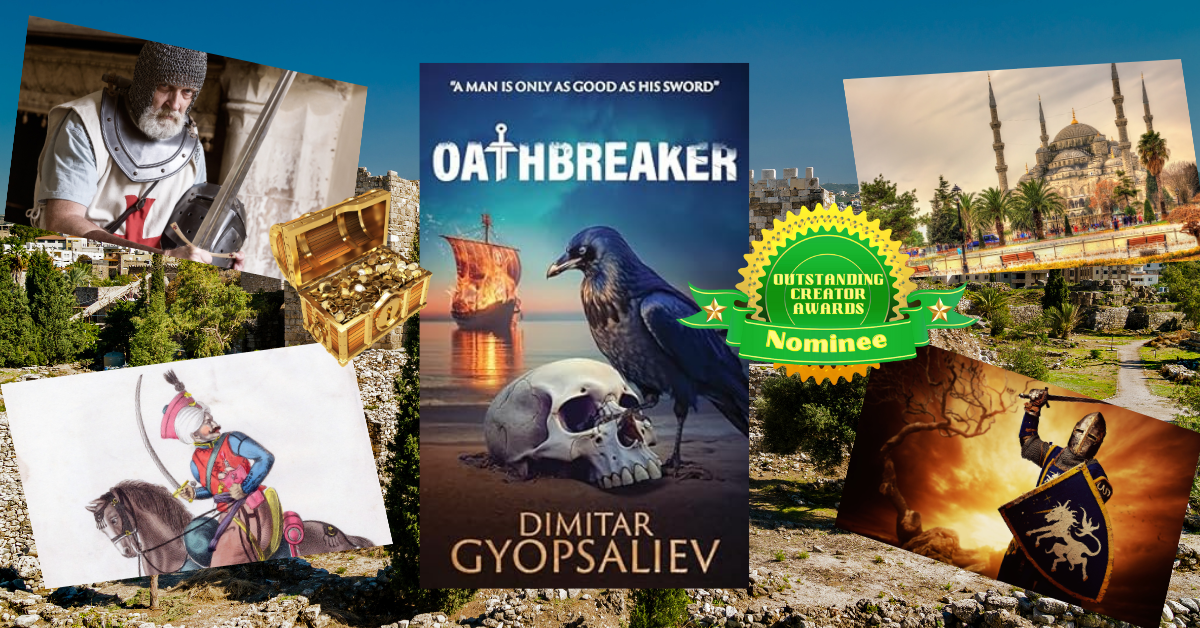 Score: 93+/100 (9.3+ out of 10)
The Crusades were a dark and disturbing time in human history. The Crusaders are often painted as being monstrous barbarians led to do unspeakable acts against their real and perceived enemies. The Muslim Arabs aren't viewed much more positively, often seen as villains—outsiders, others--in their own right. This is how most of the modern world views the Crusades and those involved. Well, Oathbreaker by Dimitar Gyopsaliev doesn't portray them that way. Instead, this impressively-researched series brings humanity, light, understanding, and rationality to what seems like a very inhumane, chaotic, dark, and irrational period in human history. It's so easy to look at historical figures and point out how foolish or terrible they seem in hindsight. However, how might we have acted if we lived there at that time? How would it have been like to be an orphan in a feudal medieval world? How would it be like to come face to face with your enemies—to hear their battle cries, to smell their breath, to have their blood splashed over your skin? How would you react? How would you feel? What would you do in the midst of battle—with your life and those of your comrades at stake? Oathbreaker does a magnificent job at putting forward the idea that the people involved in the Crusades were human beings just like us. They loved. They dreamed. They breathed. They bled. Some were as cruel and brutal as the history books say. Others were honorable, noble, and doing the best they could under unspeakable circumstances. Some got annoyed when the local bard got on their nerves. They developed crushes on women and bonded with their comrades. Oathbreaker reunites us with Peter Longsword and Owen, heroes from the previous book: an orphan-turned-soldier and a Welsh archer. Their regiment is suddenly attacked, leading Peter to act impulsively, leaving the safety of the shied wall to forward a counter-offensive. This results in the death of his friend and comrade, Adam, which haunts him throughout the duration of the novel. Adam's killer, a mysterious masked assailant, menaces Peter, compelling him to hunt them down in retaliation. Furthermore, all of the gold stores are ransacked by the enemy, leaving Peter, Owen, and company unable to purchase safe passage over the sea to return home. They are, in effect, stranded—surrounded by a mixture of friends, foes, and everything in between. Along the way, Peter and Owen encounter Gabriel the blacksmith, pirates, Mamluks, Abal (Shajar al-Durr)—a candidate for “Hottest Character” and Sultan Baibars's daughter; Ivar, Matthew, Matilda, Lady Helen, Captain Jaffar, a giant yet silent slave named Robert, and a colorful host of other characters! This book does a very good job at displaying its epic scope. The author also does a good job at showing movement and motion as the characters travel from place to place, meeting new people along the way. With that said, we were hoping that it would recapture the action-packed and violent nature of its opening again. What an opening! However, this book is more about adventuring than it is about action. Perhaps we'll see more action in the sequel(s)? The thing that we really appreciated about this book (similar to the prior one in the series) is how the book brings humanity back into what history views as a dark, immoral, violent, barbaric time in human history. On that note, we were pleasantly surprised that the Mamluks and other Arabs—despite being the sworn enemies of the Crusaders, especially in the previous book—are not portrayed as irredeemably evil or even villainous. In fact, you have a character like Captain Jaffar in this book, a Mamluk veteran who is arguably the most level-headed, fair, and unselfish character there is. There's also Robert, a huge slave who doesn't speak. Similar to someone like Michael Clarke Duncan in The Green Mile, you can't help but fall in love with this friendly giant and hope for his freedom along with Peter. Not all Arabs are bad and not all Christians are good, and vice-versa. In fact, just as there are good people on both sides, there are wicked, cruel, and morally gray people on both sides including Sir Guido, Lord Broca, Tarin, and Tarik. What's really incredible and somewhat annoying is that Peter Longsword—despite meeting and being surrounded by horrible, terrible, awful people—acts like he's Batman—it seems like he just can't let anyone die even if they deserve it. The best example of this is when he intervenes in Robert killing one of his slave masters who, quite frankly, deserved death more than anyone. We're also reminded that he saved Marco Polo, a Bedouin prince, and many other people. And that brings us to one of the underlying themes of the series: Peter's ability to unite and bring people together regardless of their differences. As Owen points out, Peter is an adopted member of Lady Eleanor's retinue and family (which is why Owen teases him as “your highness”). Owen points out that the silver scarf technically makes him part of their royal family. This makes him, technically, on the Crusaders side. However, after being involved in the saving of Sultan Baibars, he is also technically Sultan Baibar's blood-brother. So, wait a minute... does that technically make the two hottest female characters/love interests (Lady Eleanor and Abal) his... kinda-sorta-not-really-blood-oath/foster sisters? That might be overthinking things, but it's disturbing and humorous to think. Anyway, special among all Mamluks and Crusaders alike, he is venerated by both sides. This really helps to push forward the idea of an eventual peace. In fact, a cease-fire/truce exists throughou t most of the book. The problem is that Peter isn't the only thing the unites the two sides. PIRATES play a huge role in becoming thorns in the sides of both the Crusaders and Arabs, particularly the group of pirates known as Seawolves. This gives truth to the phrase: “The enemy of my enemy is my friend.” There's also a bit of mystery in this book, not just with the identity of the masked being who slayed Adam but with the discovery of a human skull early on, then the discovery of the wreckage of a ship. All of this seems to be tied to an underlying conflict involving Lord Broca, one of the biggest #$%holes of the series, and Lady Helen. We're given a scene which actually explains the cover art and the presence of the crow—a “rat of the sky”--who Peter is drawn to have a conversation with. Peter is a character who we alternated between loving and hating. There are times when he was frustrating like his careless act that resulted in Adam's death or when he prevented the slaver's death. He also seems prone to moping and throwing tantrums such as when he screams at the bard. He develops the self-defeating belief that everyone he becomes close to will die including Adam, John, and William Longsword. Others always have to tend to him and pick him up, especially Owen who is pretty much the Samwise Gamgee of the situation. This book is also pretty well-written. The author expertly weaves sentences with a special fondness for semi-colons that gave us a kick. One last thing we have to mention is that this book does eventually introduce he titular weapon, Oathbreaker, which may be a candidate for Best Weapon. Check it out on Amazon! |
Archives
April 2024
Categories |
 RSS Feed